
With the Tonor Karaoke Machine, you get 2 wireless microphones, a rechargeable Bluetooth speaker, and a built-in voice effects system all in one unit, for under $70. That’s the Tonor K20 Wireless. Tonor is a portable audio brand that built its reputation on one idea: give you everything you need to start performing at the lowest price possible, with nothing extra to buy.
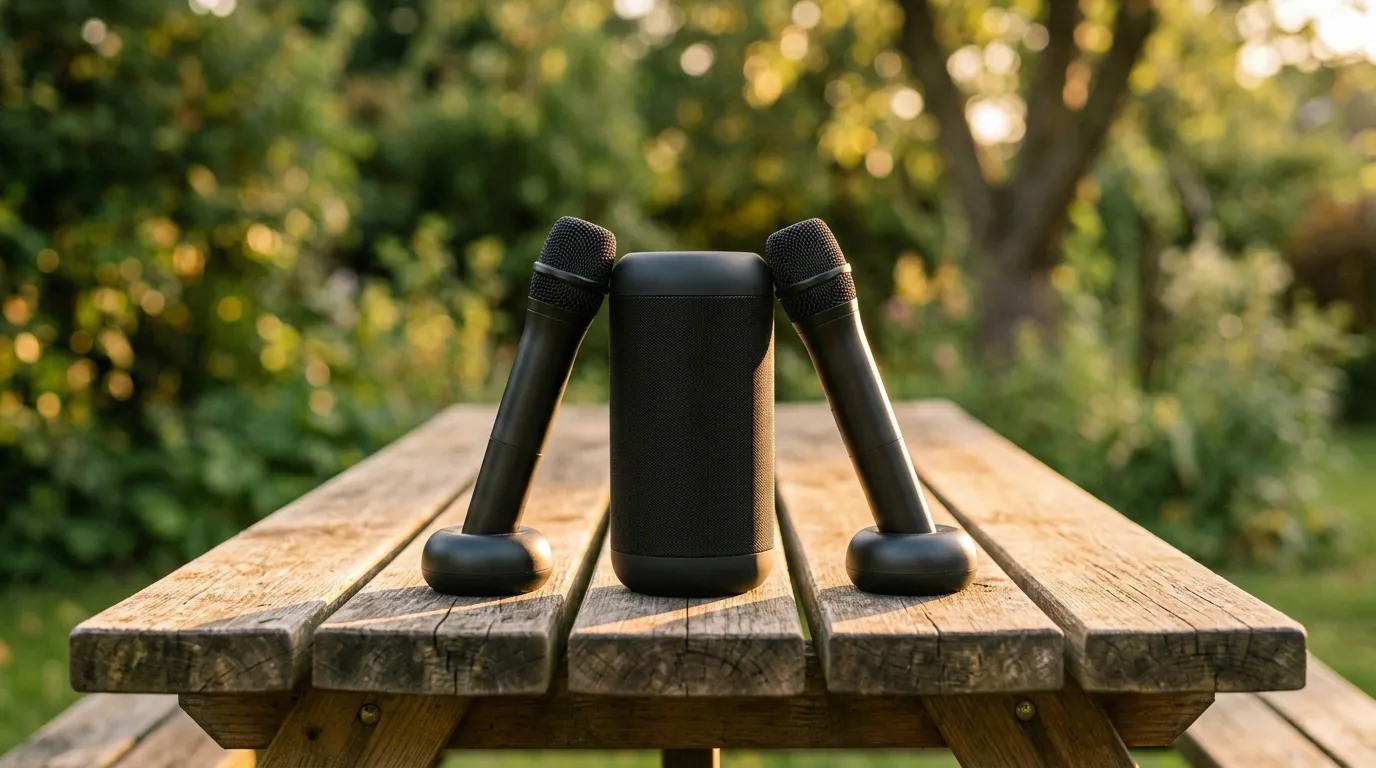
The K20 Wireless comes with Bluetooth 5.0, a 4–6 hour battery, a built-in voice effects processor, and 2 wireless mics that pair to the speaker automatically when you power it on. There’s also a higher-output version the K20 Pro at $70–$90 for anyone who needs more volume outdoors.
This page covers both models in full detail, compares Tonor honestly against JYX, iKarao, and JBL, and helps you decide which machine actually fits your situation. If you want a broader look across all portable karaoke options, the best portable karaoke machine review covers the whole category.
What Makes Tonor Different: 2-in-1 Speaker and Microphone Design
Tonor’s big differentiator is its 2-in-1 design the K20 Wireless puts the speaker and 2 wireless microphones into a single unit at $50–$70, so you don’t have to buy a speaker separately or deal with pairing separate devices before you can start performing.
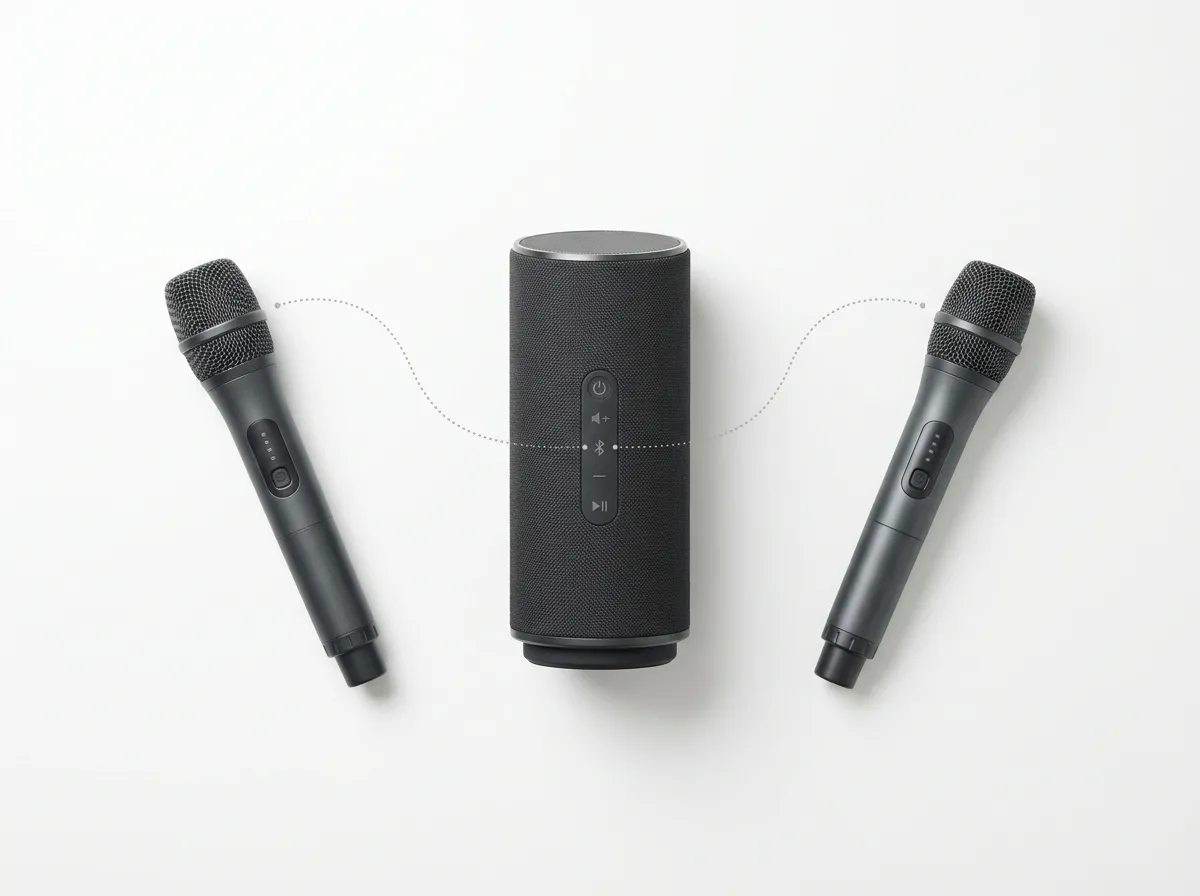
This approach has 3 practical advantages. There’s nothing extra to buy the K20 Wireless is a complete karaoke system straight out of the box. It’s genuinely portable as a single carry item, not a speaker bag plus a mic case. And setup takes seconds power it on, connect your phone over Bluetooth, and both mics are ready to go.
At $50–$70, no other brand delivers a bundled 2-wireless-mic karaoke system at this price. The next cheapest options with 2 mics included are the JYX PA9Plus at $120–$160 and the JBL PartyBox On-The-Go at $300–$350.
The trade-off is straightforward: the 2-in-1 design keeps the output in the 30–40W range and drops the built-in tracks library entirely. It’s not in the same class as the JYX PA9Plus (50W, 10,000 tracks) or JBL PartyBox (100W) for loud or large-group use. For buyers who want portability alongside a big offline tracks library, the portable karaoke machine page covers that combination.
The K20 Wireless is built for a specific buyer: someone who already uses their phone for audio, is comfortable with a Bluetooth karaoke app like KaraFun or YouTube, wants both mics included without buying extras, and needs the whole thing to fit in one bag at under $70. If that’s you, no competing machine matches it at this price. If any of those assumptions don’t apply particularly the app comfort or the small-group size the JYX PA9Plus or the JBL PartyBox are more appropriate choices from the start.
Tonor Karaoke Machine K20 Wireless Full Specification
The K20 Wireless is Tonor’s flagship it delivers 2 wireless auto-pairing microphones, Bluetooth 5.0 with 30-foot range, 4–6 hours of rechargeable battery, and a voice effects system with echo and reverb at $50–$70.
The output sits in the 30–40W class, which is enough for up to 8 people performing indoors at 60–70% volume. At full volume, you’ll hear some distortion in the high frequencies that’s normal for any 30–40W portable speaker, not a fault. If you need clean output at loud levels for a bigger group, the K20 Pro or the JYX PA18Plus are the right step up.
The wireless mics pair automatically the moment you switch the unit on no channel buttons, no frequency configuration, no manual receiver setup. Both mics operate simultaneously at 30 feet range. It’s the easiest mic setup on any machine in this price range.
Battery charges via USB-C (on current production units) and goes from flat to full in 2–3 hours. You can also run the K20 Wireless from a power bank while charging, which effectively gives you unlimited runtime in a covered setting with a power source nearby.
The K20 Wireless also works as a standalone Bluetooth speaker when you’re not doing karaoke. Any phone pairs over Bluetooth 5.0 within 30 feet, and the mic-mode and speaker-mode operate independently no reconfiguration needed when switching between the two.
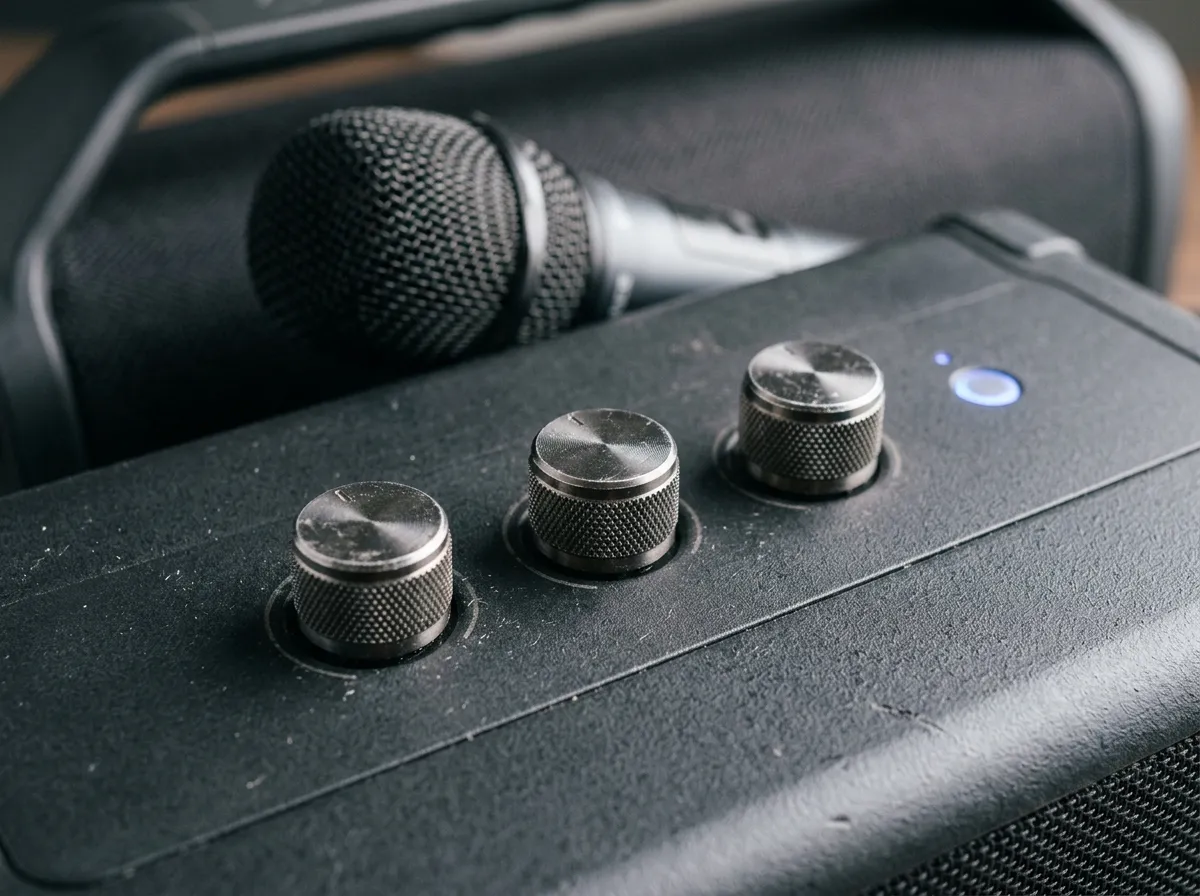
All the controls volume, echo, reverb, mic sensitivity sit on the speaker body as physical dials. You adjust everything on the machine itself without touching your phone, which is practical when your phone is propped up streaming a karaoke app.
The unit itself is built around a cylindrical form factor the style used by most portable Bluetooth speakers in this class. A carry handle sits at the top, the control dials run along the body, and the two mics dock or store alongside the unit. It’s compact enough to fit in a large bag, light enough to carry single-handed, and doesn’t need a dedicated case to transport safely between locations.
The one thing to know upfront: the K20 Wireless has no built-in offline tracks library. Every track comes from an app on your phone over Bluetooth. That’s covered in detail in the Tracks Access section below.
Full spec summary: ~30–40W | 2× auto-pair wireless mics (30ft) | Bluetooth 5.0 (30ft) | 4–6hr rechargeable battery | USB-C charging | Echo + reverb (physical dials) | Carry handle | Dual Bluetooth speaker mode | No built-in tracks | $50–$70.
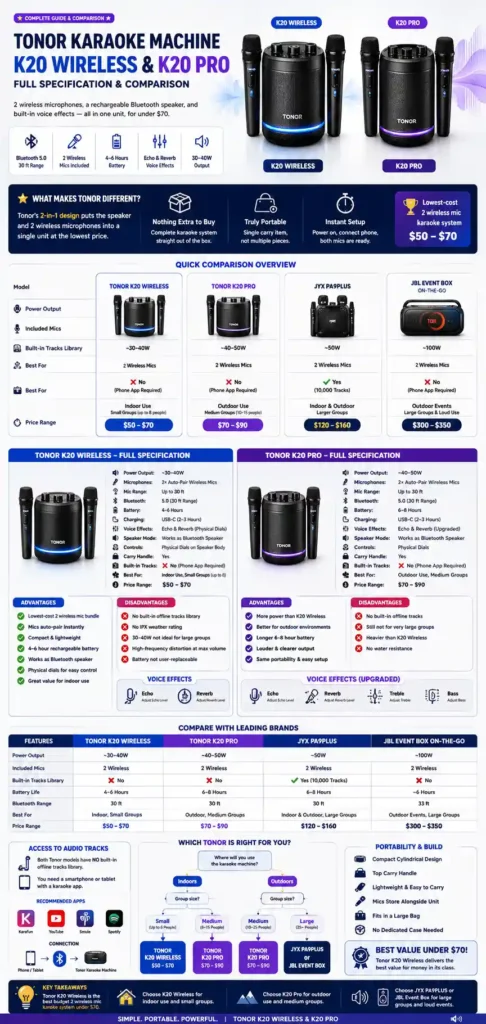
Tonor K20 Wireless: Advantages and Disadvantages
| ✅ Advantages | ❌ Disadvantages |
|---|---|
| Lowest-cost 2-wireless-mic bundle in the market $50–$70 with both mics included | No built-in offline tracks library all tracks require a phone and Bluetooth app |
| 2 mics auto-pair on power-up zero setup friction, ready in seconds | No IPX weather rating rain or water exposure risks permanent damage |
| Genuinely portable battery-powered (4–6hr), carry handle, fits in one bag | 30–40W output is sufficient indoors but underpowered for outdoor groups of 10+ |
| Works as a standalone Bluetooth speaker for non-karaoke use | words display on phone screen only no shared screen for a group to read from |
| Physical dials for all controls adjust echo and reverb without touching your phone | Auto-pairing mics offer less frequency control than UHF channel-select systems |
| USB-C charging; runs from a power bank for unlimited indoor runtime | No HDMI or TV output cannot cast to a television or external display |
| Voice effects (echo + reverb) built in improves the performing experience noticeably | No auto-tune or pitch correction voice effects are entry-level DSP only |
Voice Effects System on the K20 Wireless
The K20 Wireless includes a voice effects processor with 3 adjustable controls: echo depth, reverb level, and microphone volume all physical dials on the unit, no phone required.
Echo adds a trailing repetition to the vocal the kind of sound you hear on a stage. At 30–40% depth, it gives the voice a live feel without sounding overdone. Reverb adds room depth, making the performer sound like they’re in a larger space. At 20–30% depth it adds warmth; push it higher and the vocal starts to sound distant.
The effects on the K20 Wireless are functional and genuinely improve the karaoke experience, but they’re entry-level DSP not the same as professional amplifier processing. There’s no auto-tune or real-time pitch correction built in. If pitch correction is a must-have, the karaoke machine with auto-tune page covers machines built specifically around that feature.
A practical starting point for the K20 Wireless effects: set echo to around 35% and reverb to 25% for indoor use. That combination gives the voice a produced, confident sound without trailing awkwardly between lines. Adjust upward for larger rooms and downward for small apartments where the reverb tail bounces off hard walls.
Tonor K20 Pro What’s Different from the Standard K20
The K20 Pro is the same machine with 2 upgrades: higher output (~50–60W vs ~30–40W) and longer battery life (6–8 hours vs 4–6 hours), at $70–$90 a $20–$25 premium.
The mic system, auto-pairing, Bluetooth spec, and voice effects are identical on both models. If you’ve used the K20 Wireless, the K20 Pro feels exactly the same to operate just louder with more runtime. The extra output headroom matters most outdoors, where sound dissipates quickly and competing ambient noise (wind, other audio) eats into your effective volume.
The decision between the two models comes down to one question: where are you performing and how many people?
Choose the K20 Pro for outdoor gatherings of 10 or more people in open-air spaces garden parties, park sessions, covered outdoor venues where the standard model runs out of headroom. Choose the standard K20 Wireless for indoor use with up to 8 people, where the additional power goes unused and the $20–$25 saving is worth keeping.
| Model | Output | Battery | Price | Best For |
|---|---|---|---|---|
| Tonor K20 Wireless | ~30–40W | 4–6 hours | $50–$70 | Indoor small groups (≤8 people) |
| Tonor K20 Pro | ~50–60W | 6–8 hours | $70–$90 | Outdoor gatherings (10+ people) |
Tonor K20 Pro: Advantages and Disadvantages
| ✅ Advantages | ❌ Disadvantages |
|---|---|
| Higher output (~50–60W) handles outdoor groups of 10+ without straining | $20–$25 more expensive than the standard K20 Wireless |
| Extended battery (6–8 hours) outlasts longer outdoor sessions on a single charge | No IPX weather rating same outdoor weather limitation as the standard K20 Wireless |
| Same auto-pairing mics and voice effects as K20 Wireless identical to operate | No built-in track library same app-and-phone dependency as K20 Wireless |
| Cleaner sound at high volumes more headroom before distortion kicks in | Overkill for indoor small-group use where the standard model is perfectly adequate |
If you’re not sure which situation you’ll be in most often, start with the K20 Wireless at $50–$70. The upgrade to Pro costs only $20–$25 and the operational experience is identical so you’re not losing any learning curve if you switch later.
Portability, Battery and Outdoor Use: What to Expect
The K20 Wireless runs for 4–6 hours on battery with no mains connection needed, comes with a carry handle, and is light enough to move with one hand. That makes it practical for garden use, a friend’s house, or any setting where a power outlet isn’t guaranteed.
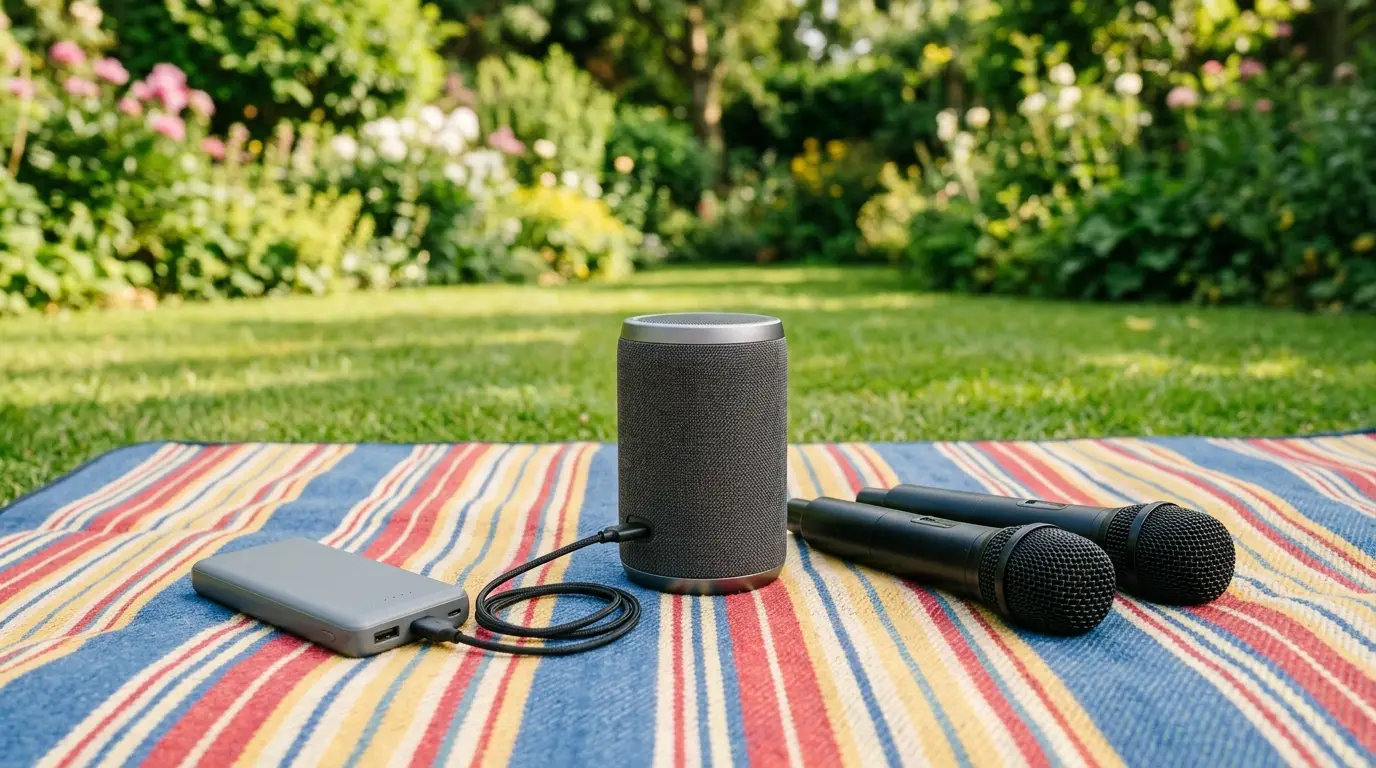
Here’s how it performs across 3 real outdoor scenarios:
Garden event, up to 10 people, dry weather. The K20 Wireless is a good fit. At 30–40W it fills a typical domestic garden at comfortable volume, the 4–6 hour battery covers most casual sessions, and the mics work reliably at 30 feet in open air.
Beach or park, open-air, unpredictable weather. This is where it gets marginal. Open spaces bleed sound quickly, so the 30–40W output sounds noticeably quieter at distance than it would indoors. More importantly, the K20 Wireless has no IPX waterproof rating rain or heavy humidity can damage the unit and won’t be covered under warranty. JBL PartyBox machines are IPX4-rated for this environment.
Venue or event, 15+ people, loud setting. The K20 Wireless isn’t the right tool here. Events at this scale need output well above 40W. The JYX PA18Plus (80–100W, $180–$250) or JBL PartyBox Encore (100W, weather-rated) are the appropriate choices. The best portable karaoke machine review covers the high-output weather-rated options in detail.
The IPX point is worth repeating clearly: the K20 Wireless is not designed for use in rain. If your outdoor sessions happen in unpredictable weather, plan for shelter or choose a machine with a weather rating.
The K20 Pro doesn’t change this it has no IPX rating either. Both Tonor models are built for fair-weather outdoor use only. The weather-protection gap between Tonor and JBL isn’t a minor spec difference; it’s the defining reason to spend the extra $250 on a PartyBox if outdoor reliability in all conditions matters to you.
Tonor Karaoke Machine vs Other Brands: Honest Comparison
Tonor wins on price and the completeness of its 2-mic bundle. It doesn’t compete with JYX on offline tracks libraries, JBL on outdoor durability and output, or iKarao on smart features and screen size. But at $50–$70 with 2 wireless mics included, nothing else matches it at that price.
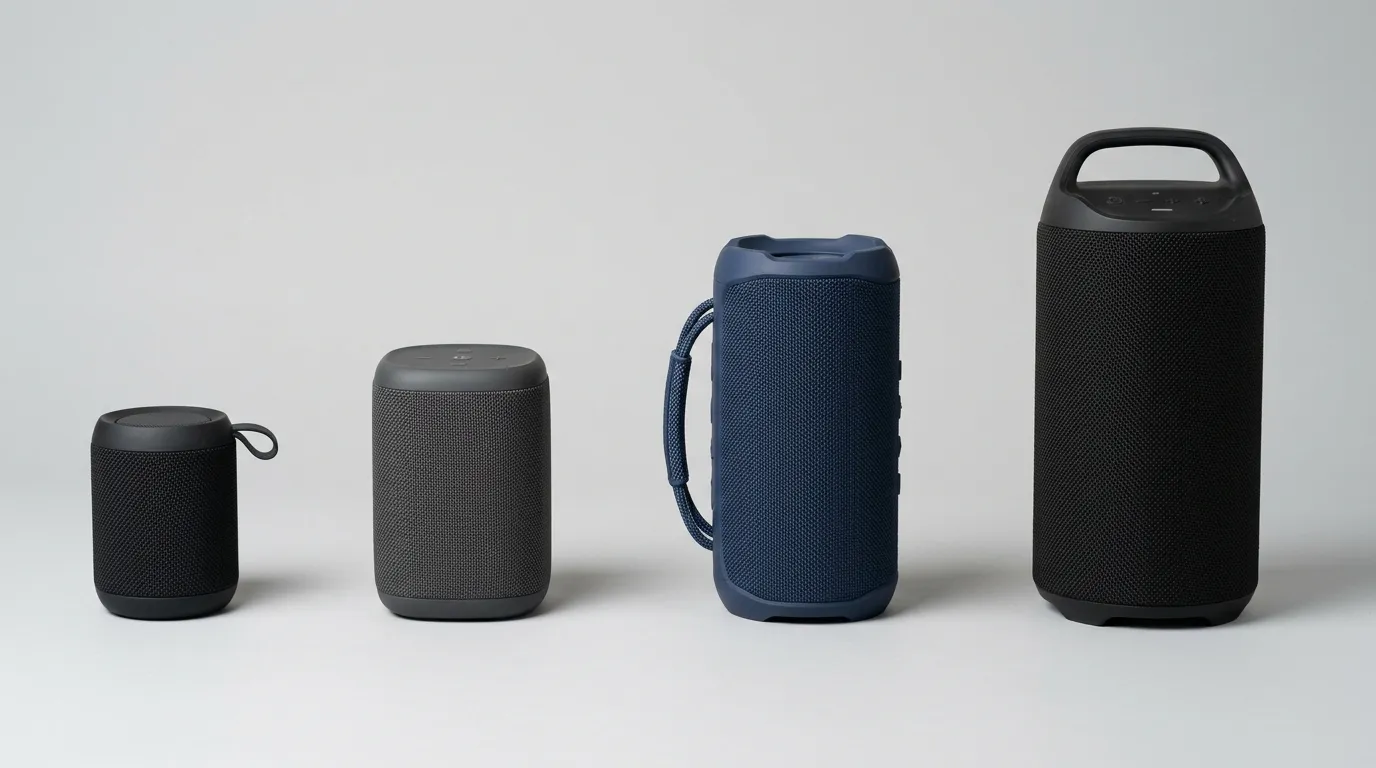
| Feature | Tonor K20 Wireless | JYX PA9Plus | iKarao Shell S1 | JBL PartyBox On-The-Go |
|---|---|---|---|---|
| Output | ~30–40W | 50W | 280W | 100W |
| Wireless Mics (standard) | 2× auto-pair (included) | 2× UHF (included) | 2× self-charging (30hr) | Not included |
| Built-in Tracks | None app only | 10,000 (no subscription) | 50,000+ (KaraFun, $9/mo) | None app only |
| IPX Rating | None | None | None | IPX4 |
| Built-in Screen | None | None | 10.1-inch IPS Android | None |
| Battery | 4–6hr rechargeable | Mains only | Mains only | 6hr rechargeable |
| Price | $50–$70 | $120–$160 | $350–$400 | $300–$350 |
Here’s who each machine is actually for:
Tonor K20 Wireless is the right call when budget is the main factor and you want 2 wireless mics included with no extra purchases. Great for casual indoor use and calm-weather garden sessions with a small group.
JYX karaoke machine the PA9Plus at $120–$160 is the right step up if you want a big offline tracks library (10,000 tracks, no subscription, no WiFi needed) and you’re happy with a mains-powered machine at home.
iKarao karaoke machine the Shell S1 at $350–$400 is the right choice if you want an Android smart system with a 10.1-inch shared screen and access to 50,000+ tracks via KaraFun. It’s 5–7× the price of Tonor and requires a $9/month subscription.
JBL karaoke machine the PartyBox On-The-Go at $300–$350 is the right choice for regular outdoor use in variable weather, where the IPX4 rating and 100W output are genuinely necessary.
The Tonor vs JBL question comes down to one thing: do you need rain protection and higher volume? If yes, JBL at $300–$350. If no, Tonor at $50–$70 covers casual use at a fraction of the cost.
One more honest point: Tonor and JYX are not competing for the same buyer on features they’re competing on value philosophy. Tonor gives you 2 mics, a speaker, and portability at $50–$70 with no offline library. JYX gives you 10,000 tracks offline at $120–$160 with no portability. Neither is wrong. They answer different questions about what matters most in a home karaoke machine.
Tracks Access on Tonor: Apps, Bluetooth Streaming and What’s Not Included
The K20 Wireless has no built-in tracks library every track comes from an app on your phone, streamed over Bluetooth. That’s the most important thing to understand before buying. JYX gives you 10,000 tracks built-in; Tonor gives you app flexibility instead.
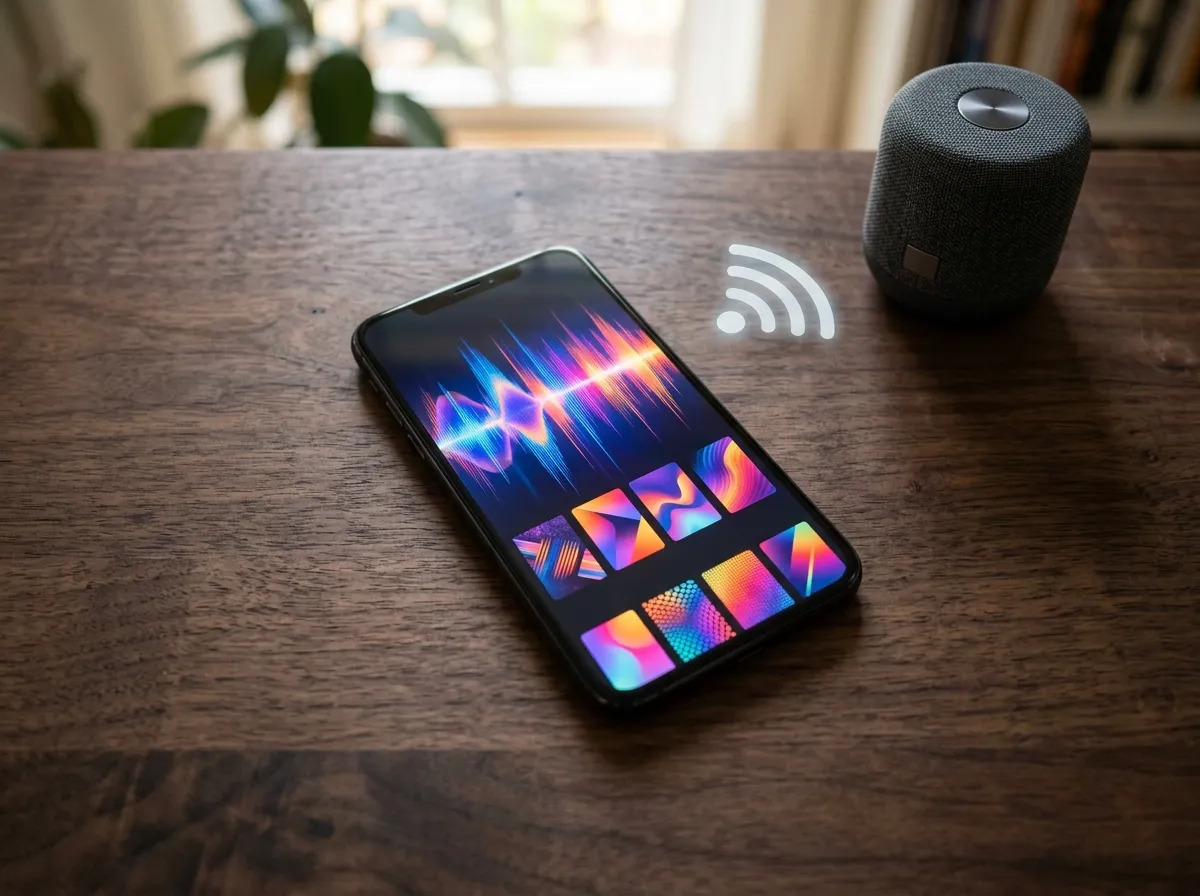
Here are the 3 most practical ways to get tracks on the K20 Wireless:
KaraFun ($9/month): KaraFun streams 50,000+ licensed karaoke tracks with real-time synced words displayed on your phone screen. It’s the biggest catalogue available for a machine without its own display. The cost adds up $108 per year on top of the $50–$70 machine price so buyers who want to avoid subscriptions should choose JYX instead.
YouTube karaoke (free): YouTube has a massive library of karaoke backing tracks with on-screen lyrics, all free. The catch is that words only show on your phone screen the K20 Wireless has no display, so a group of 4 or more people can’t all easily read along. It works well for solo performing or when the performer holds the phone.
StarMaker or Smule (free tier available): Both apps have free tiers with smaller catalogues and social features like recording and sharing your performances. Good for casual use when you don’t want a subscription, though the free catalogues are limited compared to KaraFun.
No built-in library isn’t a flaw it’s a design choice that keeps the price at $50–$70. But if you want tracks without apps or subscriptions, the JYX karaoke machine is the right alternative with 10,000 offline tracks at no extra cost. If you want words on a big shared screen instead of a phone, the iKarao karaoke machine Shell S1’s 10.1-inch Android display solves that directly.
One thing to plan for if you use YouTube karaoke with a group: words appear on the phone, not on a TV or external screen the K20 Wireless has no HDMI output and no casting capability. For an event of 6 or more, you’ll either need to prop the phone in a visible spot or pass it between performer. KaraFun handles this better than YouTube in a group setting because its interface is designed for shared use, but the phone-as-display limitation applies to both.
Review
HonestTonor Karaoke Machine
The Tonor Karaoke Machine is one of the best value options for casual home karaoke, especially for buyers looking for an affordable all-in-one setup. The K20 Wireless includes two auto-pairing wireless microphones, Bluetooth connectivity, and built-in voice effects, making it easy to start singing within minutes. While it lacks a built-in song library, display screen, and weather resistance, it delivers solid performance for small indoor gatherings. If your priority is a budget-friendly karaoke machine with simple setup and good everyday performance, the Tonor K20 Wireless is a worthwhile choice.
Frequently Asked Questions
What is the Tonor K20 Wireless karaoke machine?
The Tonor K20 Wireless is a 2-in-1 portable Bluetooth speaker and karaoke microphone system. It comes with 2 wireless auto-pairing mics, Bluetooth 5.0, a 4–6 hour rechargeable battery, and echo plus reverb voice effects at $50–$70. It’s the most-searched specific karaoke model in the entire category a budget-friendly 2-mic wireless bundle that competes directly against JYX and JBL at a fraction of the price.
Is Tonor a good karaoke machine brand?
Yes for buyers who want the lowest-cost 2-wireless-mic portable karaoke bundle on the market. At $50–$70, nothing else includes 2 wireless mics in a portable rechargeable package at the same price. It’s not the right choice if you need a large offline tracks library (JYX), outdoor weather protection (JBL), or a smart Android screen (iKarao). For casual small-group karaoke at the lowest entry cost, Tonor is the answer.
How many microphones come with the Tonor K20 Wireless?
The K20 Wireless includes 2 wireless auto-pairing microphones in the box no separate purchase needed. Both mics pair to the speaker automatically when you power the unit on, no channel setup required. Both mics work at the same time, so 2 people can sing together from the very first session with no additional hardware or configuration.
What is the difference between Tonor K20 and K20 Pro?
The K20 Pro upgrades 2 things: output (~50–60W vs ~30–40W) and battery (6–8 hours vs 4–6 hours), at $70–$90 a $20–$25 premium. Everything else mics, Bluetooth, voice effects is identical. Go with the Pro if you’re performing outdoors with 10 or more people. Stick with the standard K20 Wireless for indoor small-group sessions where the extra volume isn’t needed.
Does the Tonor karaoke machine have Bluetooth?
Yes. Bluetooth 5.0 with 30-foot range is built into the K20 Wireless for streaming karaoke apps and audio from your phone. It’s also how all your tracks get to the machine Tonor doesn’t have an offline library, so Bluetooth streaming from an app like KaraFun or YouTube is the primary way to access tracks.
Is Tonor karaoke machine good for outdoor use?
It’s good for calm, dry-weather outdoor sessions with up to 10 people garden events, picnics, backyard gatherings in good weather. The 4–6 hour battery and carry handle make it genuinely portable. The important caveat: the K20 Wireless has no IPX weather rating, so rain or water exposure can damage it permanently. For outdoor use in unpredictable conditions, JBL PartyBox (IPX4-rated) is the safer choice.
How much does the Tonor K20 Wireless cost?
The Tonor K20 Wireless costs $50–$70, making it the cheapest bundled 2-wireless-mic karaoke system in the market. The K20 Pro costs $70–$90. Both are well below the JYX PA9Plus ($120–$160), iKarao Break X1 ($150–$200), and JBL PartyBox On-The-Go ($300–$350) all of which also include 2 mics as standard but at significantly higher price points.
Is Tonor better than JBL for karaoke?
It depends entirely on what you need. Tonor wins on price $50–$70 with 2 wireless mics included vs JBL PartyBox at $250–$400 with no wireless mics in the box. JBL wins on everything else: 100W–240W output, IPX4 splash resistance, and JBL’s bass quality. For casual indoor or calm-weather outdoor use on a budget, Tonor is the better value. For sustained outdoor karaoke in any weather, JBL is the right machine.