
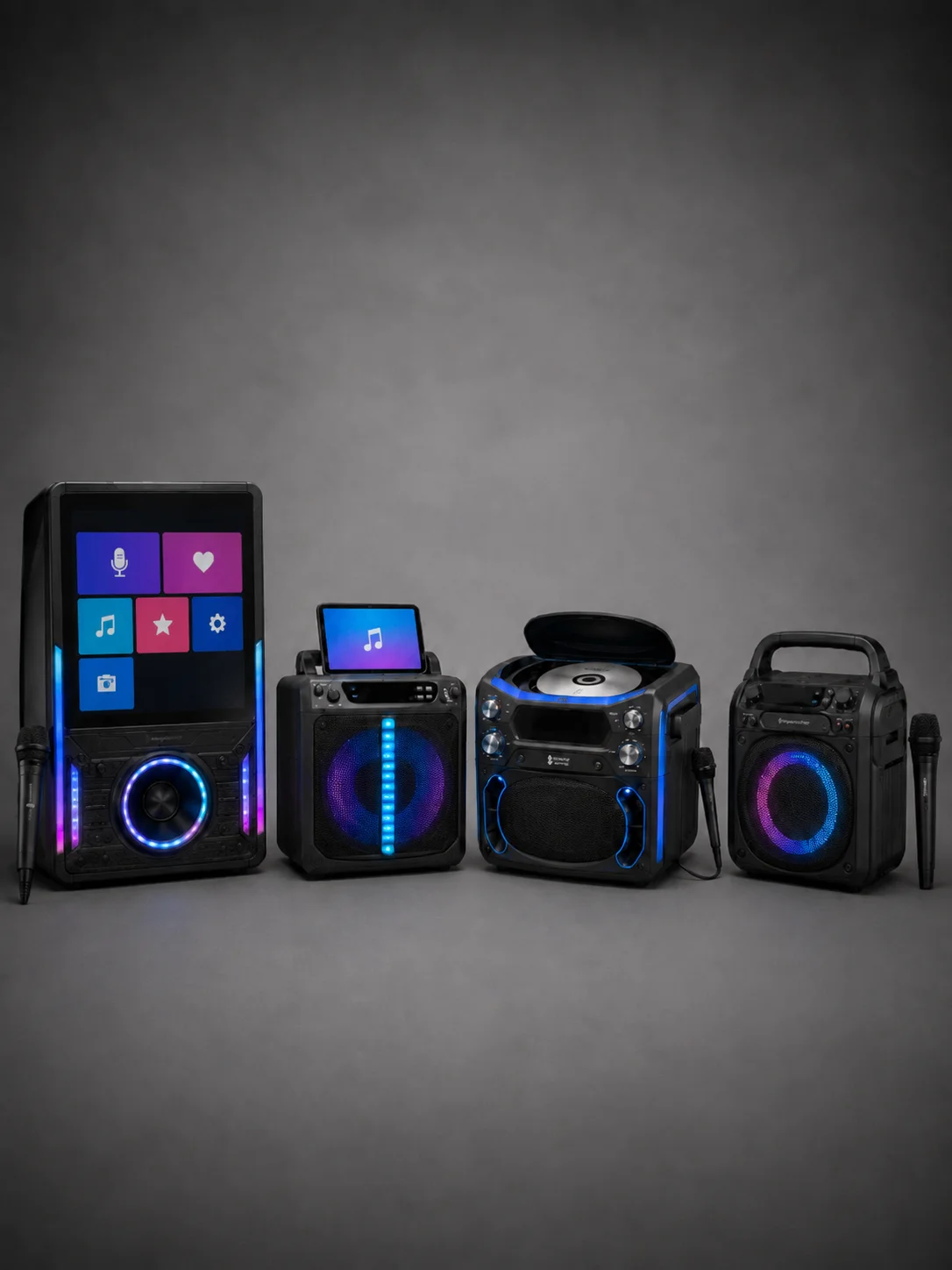
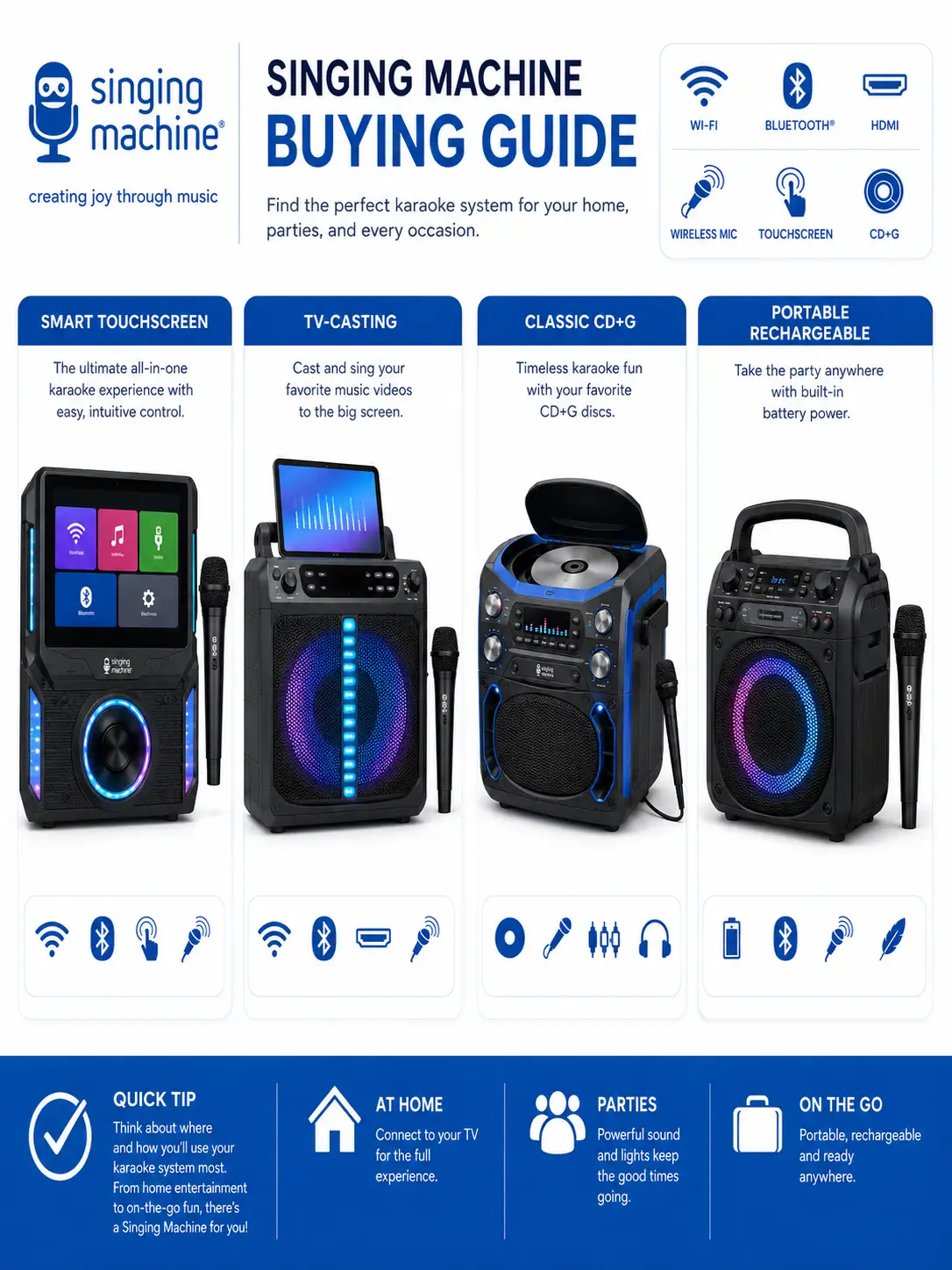
Singing Machine makes several different types of home karaoke systems rather than one standard “Singing Machine karaoke machine.” Its current range includes Wi-Fi touchscreen systems, TV-casting models, traditional CD+G machines, Bluetooth systems, portable units, and kids-focused products. Singing Machine currently organizes its catalog into Smart Karaoke, Classic Karaoke, Kids Karaoke, and microphone categories.
Table of Contents
For buyers comparing current models, the main distinction is how the system accesses karaoke content and displays lyrics. The Platinum PLUS and Karaoke Hub 2.0 provide built-in smart interfaces, Singcast models are designed around phone/app and TV integration, while models such as the SML385 retain traditional CD+G playback alongside Bluetooth and USB support.
Research note: Smart Karaoke Machine has not physically tested the products in this guide. Specifications and model information below are based primarily on current Singing Machine product pages, support documentation, and manuals. Prices can change and should be treated as time-sensitive.
Singing Machine Karaoke Machines at a Glance
| Model | Product Type | Main Features | Included Mic Setup | Manufacturer Price* |
|---|---|---|---|---|
| Platinum PLUS ISM9022 | Smart Wi-Fi system | Touchscreen, Wi-Fi, HDMI, Bluetooth, USB recording, 22 voice effects | 2 wireless mics | $349.99 |
| Karaoke Hub 2.0 ISM9015 | Smart touchscreen system | 10″ touchscreen, Wi-Fi, Bluetooth, HDMI, recording, 22 voice effects | 2 digital wireless mics | $299.99 |
| Singcast Max SMC2035 | TV-casting system | 35W RMS, SingCast, Bluetooth, HDMI, pitch correction, recording | 1 wired mic | $149.99 |
| Groove DISCO SML722 | Portable Bluetooth system | Rechargeable battery, Bluetooth, USB recording, voice effects, lighting | 2 wireless mics | $129.99 |
| Singcast One SMC2020 | Compact TV-casting system | Video casting, Bluetooth, line-in, lights, echo | 1 wireless mic | $99.99 |
| SML385 | Classic CD+G system | CD+G, USB, Bluetooth, RCA TV output, dual mic inputs | 1 wired mic | $79.99 |
| Groove Cube Mini SML654 | Compact classic/Bluetooth system | Bluetooth, HDMI lyric output, voice effects, battery option | Check current package | $59.99 |
*Manufacturer-listed prices checked August 23, 2026. Retailer pricing, promotions, and availability can differ.
What Is Singing Machine?
Singing Machine is a consumer karaoke brand that says it was founded in California in 1982. The company originally focused on professional and semi-professional equipment before moving into home karaoke products, and today its catalog is primarily built around consumer systems, accessories, and karaoke software.
That history is visible in the current range. Some models still use traditional karaoke formats such as CD+G, while newer systems rely on Wi-Fi applications, Bluetooth streaming, digital wireless microphones, HDMI output, and the Singing Machine Karaoke app.
The Singing Machine app currently advertises access to 100,000+ karaoke tracks, with video, lyrics-only modes, optional lead-vocal tracks on supported content, and playlist/DJ functionality. Full catalog access requires a subscription after applicable trial offers.
Singing Machine Platinum PLUS ISM9022
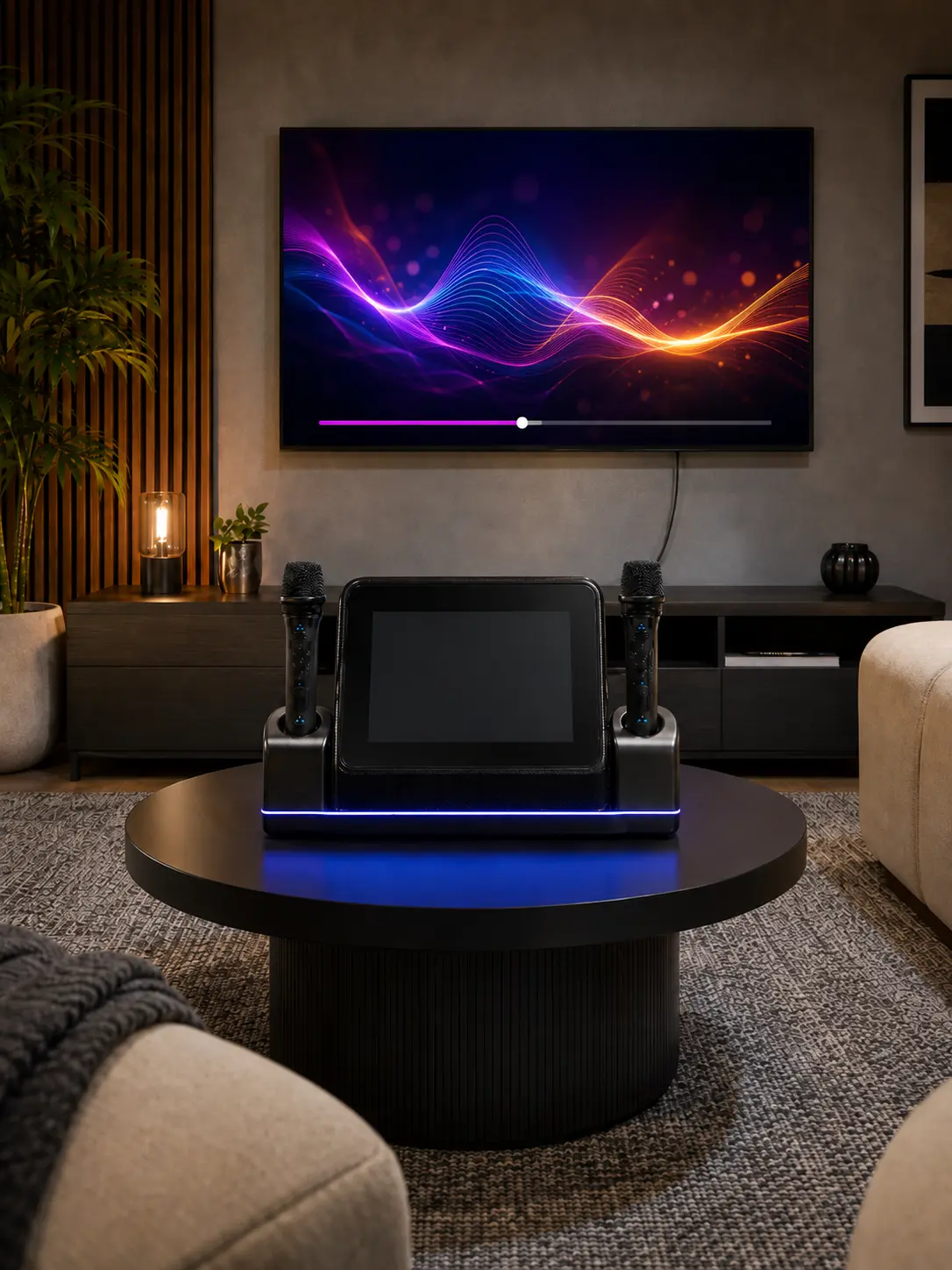
The Platinum PLUS ISM9022 is one of Singing Machine’s current premium smart systems. It combines a built-in touchscreen with Wi-Fi access, Bluetooth streaming, HDMI output, USB playback and recording, two wireless microphones, lighting, and 22 voice effects. Singing Machine currently lists it at $349.99.
Its primary advantage over older Singing Machine designs is that the system does not depend on a CD+G collection or a phone for basic navigation. The built-in interface can access applications directly, while HDMI can send lyrics and video to a larger television.
Singing Machine’s support documentation makes an important HDMI distinction: on the ISM9022, HDMI sends video and lyrics to the television, while the machine itself handles the audio and microphone sound. Buyers should therefore not assume HDMI will route the complete karaoke mix through the TV.
Platinum PLUS Key Features
| Attribute | ISM9022 |
|---|---|
| Built-in touchscreen | Yes |
| Wi-Fi | Yes |
| Bluetooth | Yes |
| HDMI output | Yes, for TV video/lyrics |
| Wireless microphones | 2 |
| Wired mic support | Yes |
| Voice effects | 22 |
| USB recording | Yes |
| CD+G | No |
| Current manufacturer price | $349.99 |
One specification deserves caution. Singing Machine’s current retail page describes broader Wi-Fi functionality than its support page, while the support documentation specifically references 2.4GHz Wi-Fi for ISM9022. Because the manufacturer’s own pages are not perfectly aligned, this guide does not treat dual-band Wi-Fi as a confirmed universal specification for every ISM9022 unit.
Best fit: buyers who want a self-contained smart interface rather than relying mainly on CDs or a phone.
For more options with a similar self-contained design, check out our guide to the best all-in-one karaoke machines.
Singing Machine Karaoke Hub 2.0 ISM9015
The Karaoke Hub 2.0 is another current smart model and is listed at $299.99. It uses a 10-inch touchscreen, supports Wi-Fi and Bluetooth, provides HDMI output, includes recording functions, and comes with two digital wireless microphones.
Singing Machine specifies up to 5 hours of microphone operation and a range of over 20 meters for the included wireless microphones. Those figures are manufacturer specifications rather than measurements performed by Smart Karaoke Machine.
The Hub 2.0 can also connect to a television through HDMI. As with Platinum PLUS, Singing Machine’s support documentation says the HDMI connection is for video and lyrics; the audio and microphone mix remain on the karaoke unit.
Karaoke Hub 2.0 vs Platinum PLUS
Both models occupy Singing Machine’s smart-karaoke category, so the buying decision is less about whether they support streaming and more about their exact hardware, current price, and interface.
The Hub 2.0 has a manufacturer-specified 10-inch touchscreen and currently costs $50 less than Platinum PLUS. Platinum PLUS is positioned by Singing Machine as the higher-tier Wi-Fi model and provides similar smart-app, HDMI, Bluetooth, recording, effects, and dual-microphone functionality.
For either model, check the current product listing before purchase because Singing Machine updates software, app access, bundles, and promotional pricing independently of the physical model name.
Singing Machine Singcast Max SMC2035
The Singcast Max takes a different approach. Instead of putting the main karaoke interface on a built-in touchscreen, it is designed around SingCast and television integration.
Singing Machine currently specifies 35W RMS output, Bluetooth 5.0, up to 30 feet/10 meters of Bluetooth range in open space, 2.4GHz Wi-Fi, a wired dynamic microphone, recording/playback, voice effects, and pitch-correction functionality.
Its current manufacturer price is $149.99, reduced from a listed $169.99 at the time this guide was checked.
Singcast Max Key Specifications
| Attribute | SMC2035 |
|---|---|
| Output | 35W RMS |
| Bluetooth | Version 5.0 |
| Manufacturer Bluetooth range | Up to 30 ft / 10 m in open space |
| Wi-Fi | 2.4GHz |
| HDMI | Yes, for TV/SingCast setup |
| Included microphone | 1 wired microphone |
| Voice effects | Yes |
| Pitch correction | Yes |
| Recording | Yes |
| Current manufacturer price | $149.99 |
This is a better semantic fit for someone who already intends to use a TV as the main display rather than paying for a separate built-in touchscreen.
To learn more about connecting your system to an external display, read our step-by-step guide on how to connect a karaoke machine to a TV.
Singing Machine SML385: The Classic CD+G Option
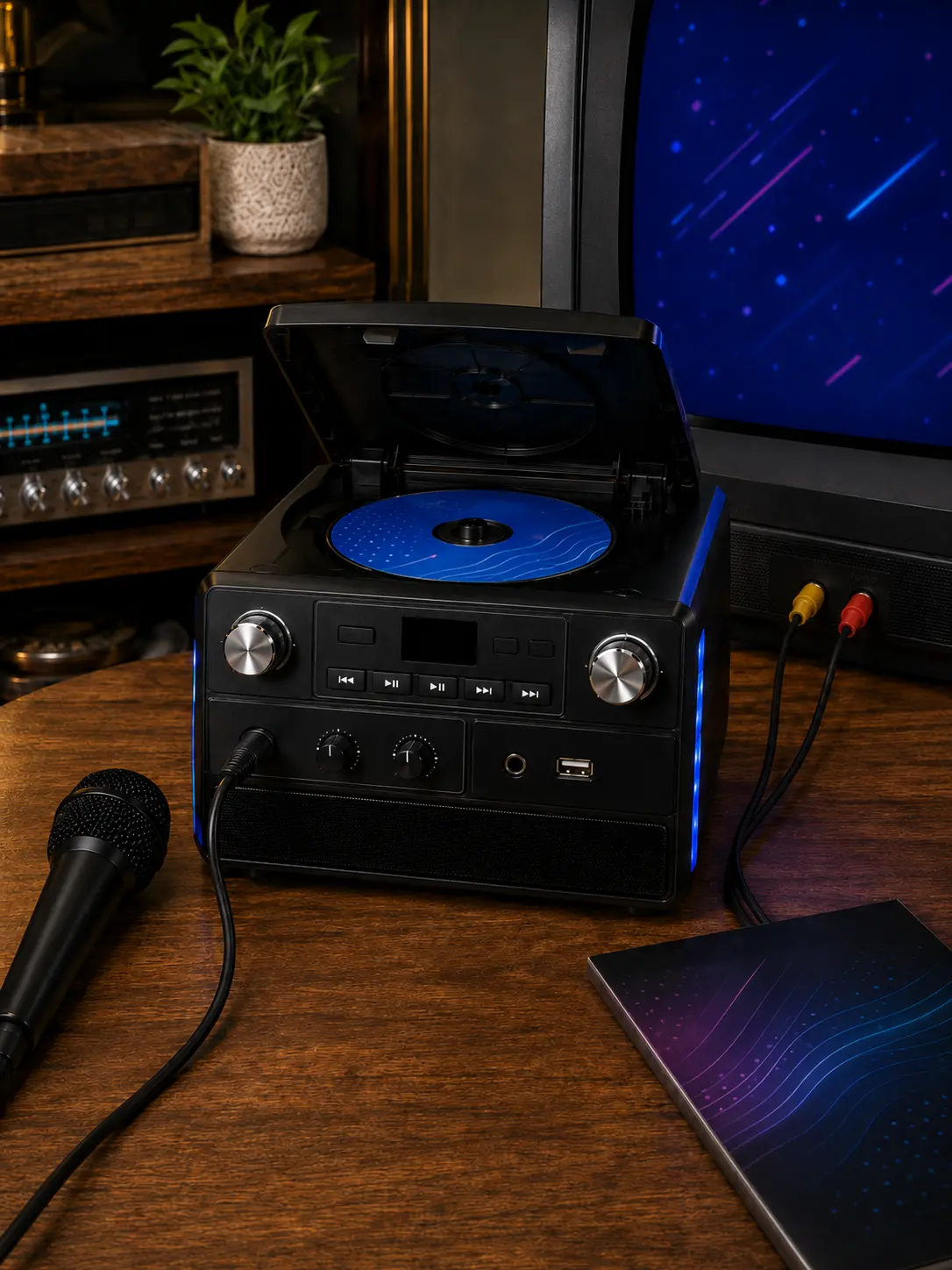
The SML385 represents the older but still-current side of the Singing Machine catalog. It remains listed at $79.99 and supports a top-loading CD player that reads both standard audio CDs and CD+G karaoke discs.
It also supports USB playback/recording, Bluetooth audio streaming, line-in, two wired microphone inputs with separate volume controls, echo, and RCA connections for displaying CD+G lyrics on a television. One wired microphone and RCA cables are included in the current package.
The SML385 therefore serves a very different buyer from Platinum PLUS:
Platinum PLUS
→ smart interface
→ Wi-Fi applications
→ HDMI
→ wireless microphones
SML385
→ CD+G
→ Bluetooth
→ USB
→ RCA television connection
→ wired microphones
The SML385 is more appropriate when maintaining compatibility with an existing CD+G collection matters more than having a built-in smart interface.
Singing Machine Singcast One SMC2020
The Singcast One is currently listed at $99.99 and focuses on compact TV-based karaoke. Singing Machine lists video-casting capability, Bluetooth audio, echo, synchronized lights, line-in, lead-vocal-removal functionality, and one included wireless microphone.
Unlike Platinum PLUS or the Hub 2.0, there is no built-in touchscreen. The intended workflow is closer to:
phone/app → Singcast system → television
That makes it a lower-cost route into Singing Machine’s screen-casting ecosystem for buyers who already have a suitable television and mobile device.
Singing Machine Groove DISCO SML722
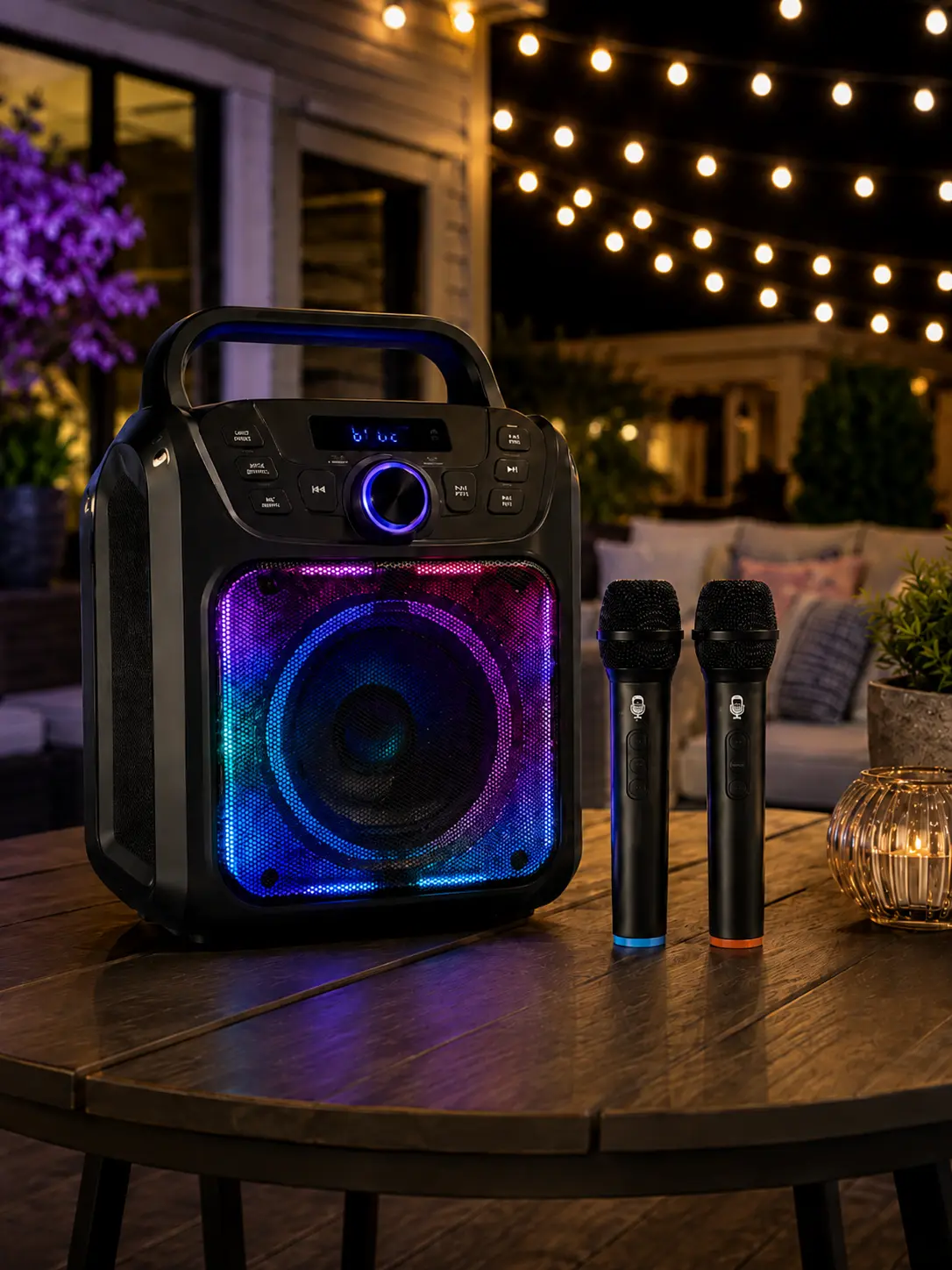
The Groove DISCO is aimed more toward portable, party-oriented use. The current product page lists Bluetooth streaming, USB recording, 22 voice-changing effects plus echo, lead-vocal removal, synchronized lighting, a rechargeable lithium-ion battery, two wireless microphones, and two additional wired microphone ports. It is currently priced at $129.99.
Because it has its own rechargeable battery, it has a different use case from mains-powered smart units such as Platinum PLUS. It does not, however, provide the same built-in smart touchscreen experience.
So the choice is essentially:
Groove DISCO
→ portability + rechargeable battery + microphones + lighting
versus:
Platinum PLUS / Hub 2.0
→ smart interface + Wi-Fi + built-in touchscreen + HDMI
If you prioritize battery power and mobility, view our top recommendations in the best portable karaoke machines comparison guide.
Singing Machine Groove Cube Mini
The Groove Cube Mini SML654 is one of the lower-cost products currently listed by Singing Machine at $59.99. It supports Bluetooth, six voice-changing effects, synchronized LED lighting, two microphone inputs, line-in connectivity, and HDMI output for displaying CD+G lyrics on a TV. It can also operate from six C-size batteries instead of the AC adapter.
There is an important manufacturer-content inconsistency on the current listing: the feature section says two wired microphones are included, while the “What’s Included” section lists one wired microphone. Because those two sections conflict, buyers should verify the exact package contents before purchase rather than relying on either number as a settled specification.
This is a good example of why product data should be reconciled rather than silently guessed when primary sources disagree.
Smart Karaoke vs Classic Karaoke: Which Singing Machine Type Is Different?
Singing Machine currently divides much of its range into Smart Karaoke and Classic Karaoke categories.
Smart Karaoke
Smart systems prioritize:
- Wi-Fi or app-based content
- touchscreen or TV interfaces
- digital content access
- HDMI or casting
- wireless microphones on selected models
- recording and voice effects
Examples include Platinum PLUS, Karaoke Hub 2.0, and Singcast Max.
Classic Karaoke
Classic systems place more emphasis on:
- Bluetooth
- CD+G or external source playback
- wired microphone inputs
- RCA or HDMI display connections depending on model
- simpler hardware controls
The SML385 is the clearest current example because it still supports CD+G discs while adding Bluetooth and USB functionality.
How Singing Machine Displays Lyrics on a TV
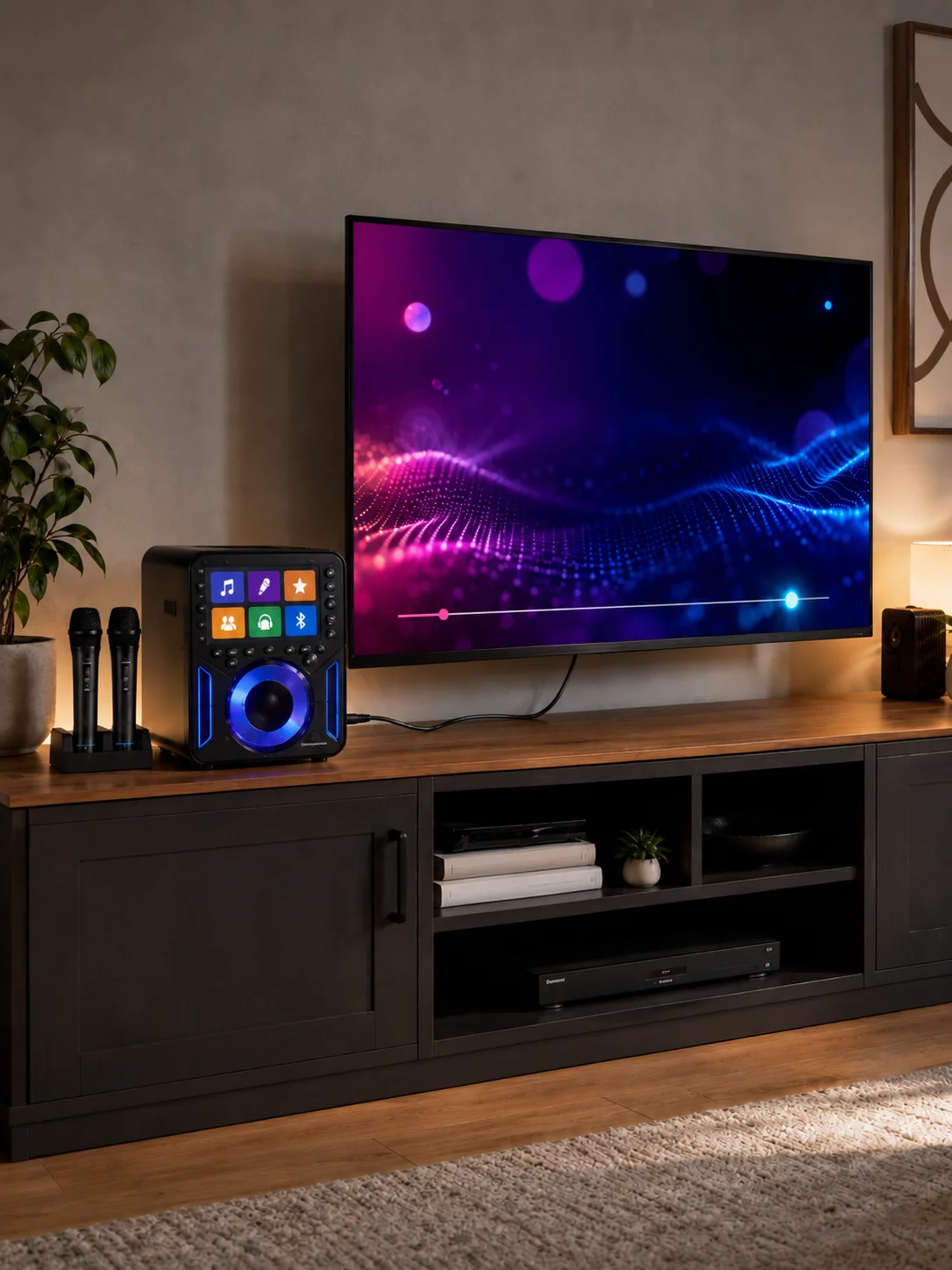
There is no single TV-connection method across the full Singing Machine range.
Newer smart systems such as Platinum PLUS and Karaoke Hub 2.0 use HDMI output for video and lyrics. Singing Machine’s support documentation specifically notes that those HDMI connections do not send the microphone/audio mix through the television.
Older designs such as the SML385 use RCA/AV output for CD+G lyrics. When Bluetooth or line-in is used on the SML385, Singing Machine’s support documentation says those modes do not generate TV lyrics through the RCA output.
This distinction matters when choosing a model: Bluetooth audio support does not automatically mean the karaoke machine can display lyrics from that Bluetooth source on the TV.
For details on managing audio routing and video feeds over digital connections, see our guide on karaoke machine HDMI setup.
Which Singing Machine Karaoke Machine Fits Which Setup?
For a self-contained smart system, the Platinum PLUS and Karaoke Hub 2.0 are the strongest matches in the current lineup because both combine screen-based navigation with Wi-Fi, Bluetooth, HDMI, and wireless microphones.
For a TV-centered setup at a lower price, Singcast Max or Singcast One make more sense because their product design assumes a phone/app and external display will handle more of the interface.
For CD+G compatibility, the SML385 remains the most obvious current choice.
For portable rechargeable use, Groove DISCO is better aligned with that requirement than the mains-focused smart models.
For a lower-cost compact machine, Groove Cube Mini offers Bluetooth, effects, TV lyric support, and battery operation, although the manufacturer currently provides conflicting information about the exact microphone bundle.
These are research-based use-case distinctions rather than hands-on performance rankings.
Singing Machine App and Track Access
Singing Machine’s current app promotes access to 100,000+ karaoke tracks, with videos, lyrics-only modes, optional lead vocals on supported titles, and a DJ queue that can hold up to 100 selections.
New compatible machines may include a promotional trial, but full catalog access requires a subscription once the applicable trial period ends. Singing Machine’s current Wi-Fi setup documentation describes a one-month trial for eligible new systems.
This means the hardware price is not necessarily the total long-term cost if the buyer intends to use the full subscription catalog.
Singing Machine Warranty
Singing Machine currently states that its karaoke machines include a 90-day warranty from the date of purchase when purchased from an authorized distributor or retailer, with proof of purchase required for warranty service.
Warranty terms can change, so the current manufacturer policy should be checked when purchasing.
Frequently Asked Questions
What is the best Singing Machine karaoke machine?
There is no single model that fits every setup. Platinum PLUS and Karaoke Hub 2.0 are the strongest current choices for built-in smart interfaces, while SML385 is better suited to buyers who still use CD+G discs.
Does Singing Machine make Wi-Fi karaoke machines?
Yes. Current Wi-Fi models include Platinum PLUS and Karaoke Hub 2.0. Both provide built-in screen interfaces and can connect to a television through HDMI.
Does a Singing Machine karaoke machine connect to a TV?
Many do, but the connection depends on the model. New smart models can use HDMI, while models such as the SML385 use RCA/AV output for CD+G lyrics.
Does Singing Machine support Bluetooth?
Many current Singing Machine systems support Bluetooth, including Platinum PLUS, Karaoke Hub 2.0, Singcast Max, SML385, Singcast One, Groove DISCO, and Groove Cube Mini. Bluetooth functionality and TV-lyric behavior vary by model.
Does Singing Machine still make CD+G karaoke machines?
Yes. The SML385 remains in the current catalog and supports both standard CDs and CD+G discs.
Do Singing Machine karaoke machines include microphones?
Many models include at least one microphone, but the number and type vary. Platinum PLUS and Karaoke Hub 2.0 include two wireless microphones, Singcast Max includes a wired microphone, and SML385 includes one wired microphone.
Does HDMI send Singing Machine audio to the TV?
Not on every model. Singing Machine’s current support documentation for Platinum PLUS and Karaoke Hub 2.0 says HDMI sends video and lyrics to the TV while audio and microphone sound remain on the karaoke unit.
How much does a Singing Machine karaoke machine cost?
At manufacturer pricing checked August 23, 2026, the current models covered here range from $59.99 for the Groove Cube Mini to $349.99 for Platinum PLUS. Prices and promotions can change.
Final Comparison
Singing Machine’s current catalog covers several different karaoke architectures rather than one universal design. Platinum PLUS and Karaoke Hub 2.0 emphasize built-in smart interfaces; Singcast Max and Singcast One emphasize television and app integration; SML385 keeps CD+G compatibility; and Groove DISCO and Groove Cube Mini serve more portable or lower-cost setups.
The most important buying step is therefore not simply choosing a Singing Machine model by price. Decide first whether you need a built-in screen, Wi-Fi access, TV casting, CD+G playback, wireless microphones, battery operation, or a traditional wired setup, then compare only the models that support those requirements.
Sources and Verification
Product specifications in this guide were checked primarily against Singing Machine’s current product catalog, individual product pages, support documentation, and product-manual index in August 2026. Where Singing Machine’s own pages conflict, the conflict is identified rather than resolved through assumption.