Mini Karaoke Machine: Size, Weight and What You Get at This Scale
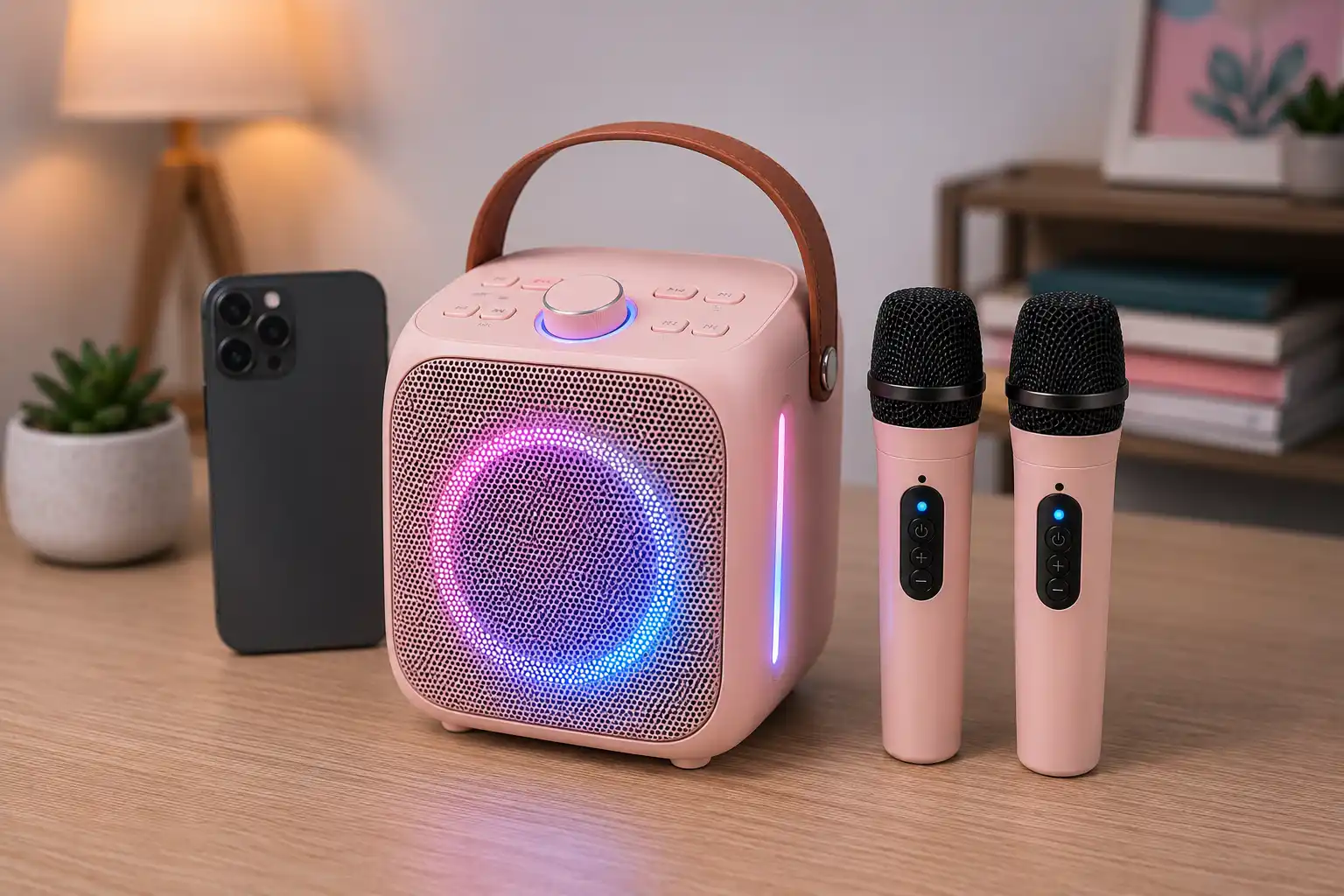
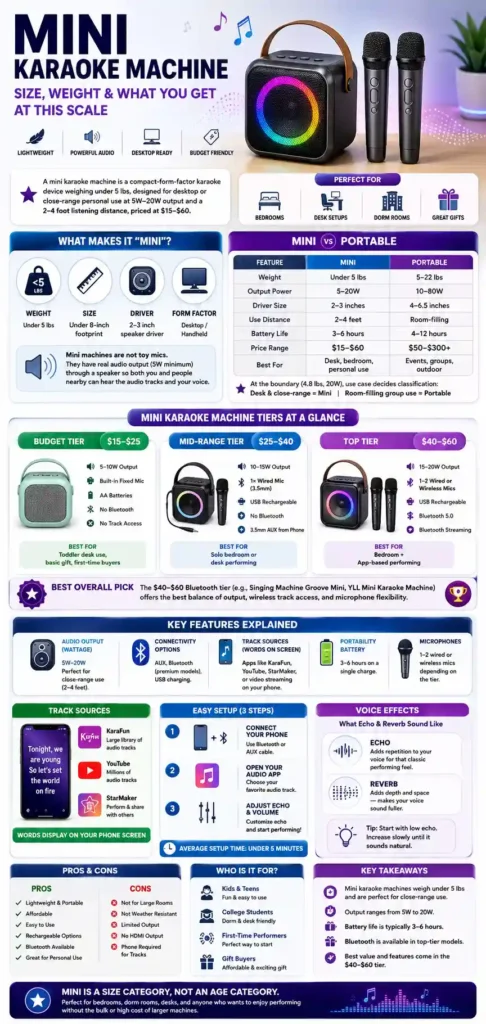
A mini karaoke machine is a compact-form-factor karaoke device weighing under 5 lbs, designed for desktop or close-range personal use at 5W–20W output and a 2–4 foot listening distance, priced at $15–$60.
Table of Contents
Mini is a size category, not an age category it suits a teenager’s bedroom, a dorm room desk, or a gift for a first-time performer just as easily as it suits a child’s playroom. This page defines what mini means as a measurable category, explains the specs you’ll actually get, and walks through every feature tier so you know exactly what your budget buys. The terms portable mini karaoke machine and mini portable karaoke machine are used interchangeably in search both refer to the same size category covered here.
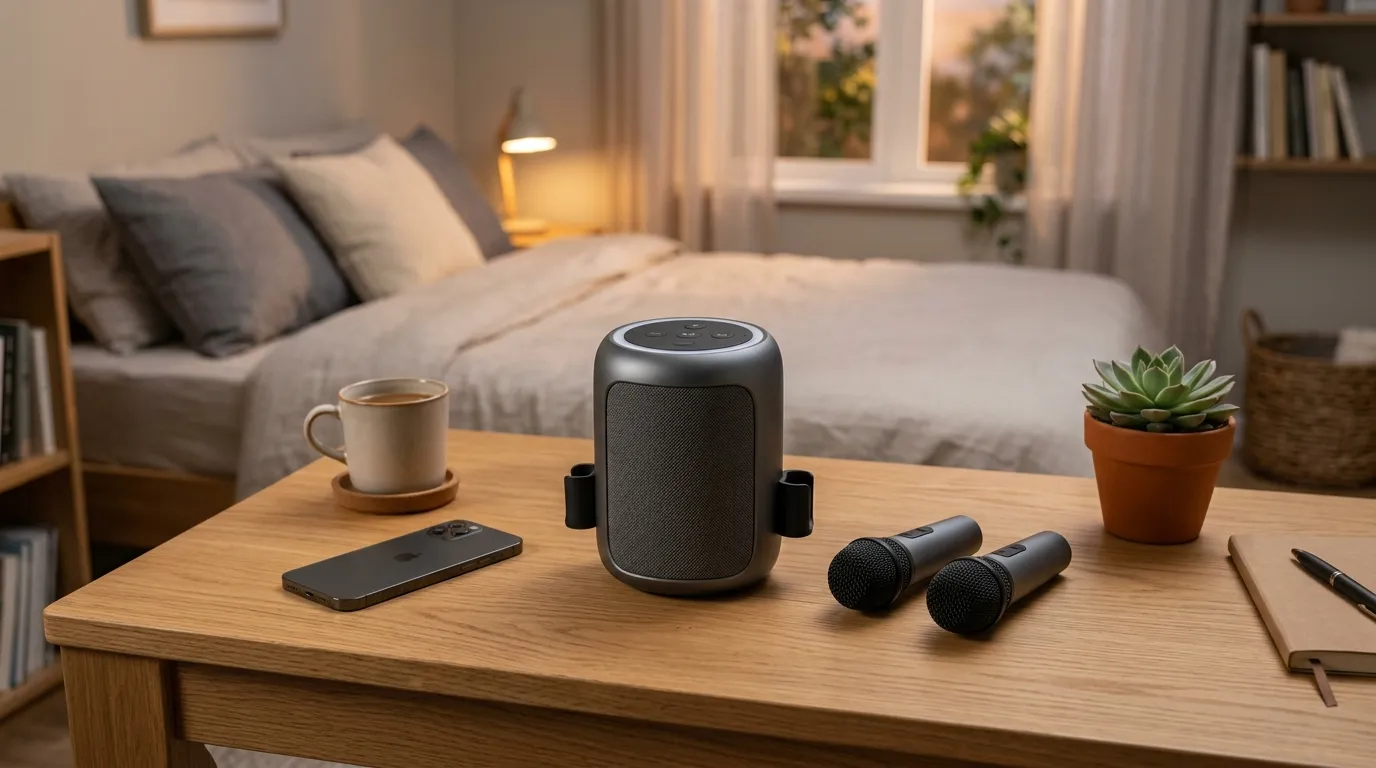
For ranked picks, the best karaoke machine review covers the top-rated options in each price band.
Quick Comparison: Mini Karaoke Machine Tiers at a Glance
| Tier | Output | Microphone | Battery | Bluetooth | Track Access | Best For | Price |
|---|---|---|---|---|---|---|---|
| Budget | 5–10W | Built-in fixed | AA batteries | No | None | Toddler desk use, basic gift | $15–$25 |
| Mid-Range | 10–15W | 1× wired (3.5mm) | USB-rechargeable | No | 3.5mm AUX from phone | Solo bedroom or desk performing | $25–$40 |
| Top Tier | 15–20W | 1–2× wired or wireless | USB-rechargeable | Yes | Bluetooth streaming | Bedroom + app-based karaoke | $40–$60 |
Best Overall Pick: The $40–$60 Bluetooth tier specifically models like the Singing Machine Groove Mini or YLL mini karaoke machine delivers the best balance of output, wireless track access, and microphone flexibility for most buyers. If budget is no constraint within the mini category, look for a unit with 2 wireless microphones, Bluetooth, and USB-rechargeable battery in the $45–$60 range.
What Makes a Karaoke Machine ‘Mini’?
A karaoke machine qualifies as mini when it weighs under 5 lbs and uses a desktop or handheld form factor machines between 5 and 10 lbs are classified as portable, not mini, regardless of how a manufacturer markets them.
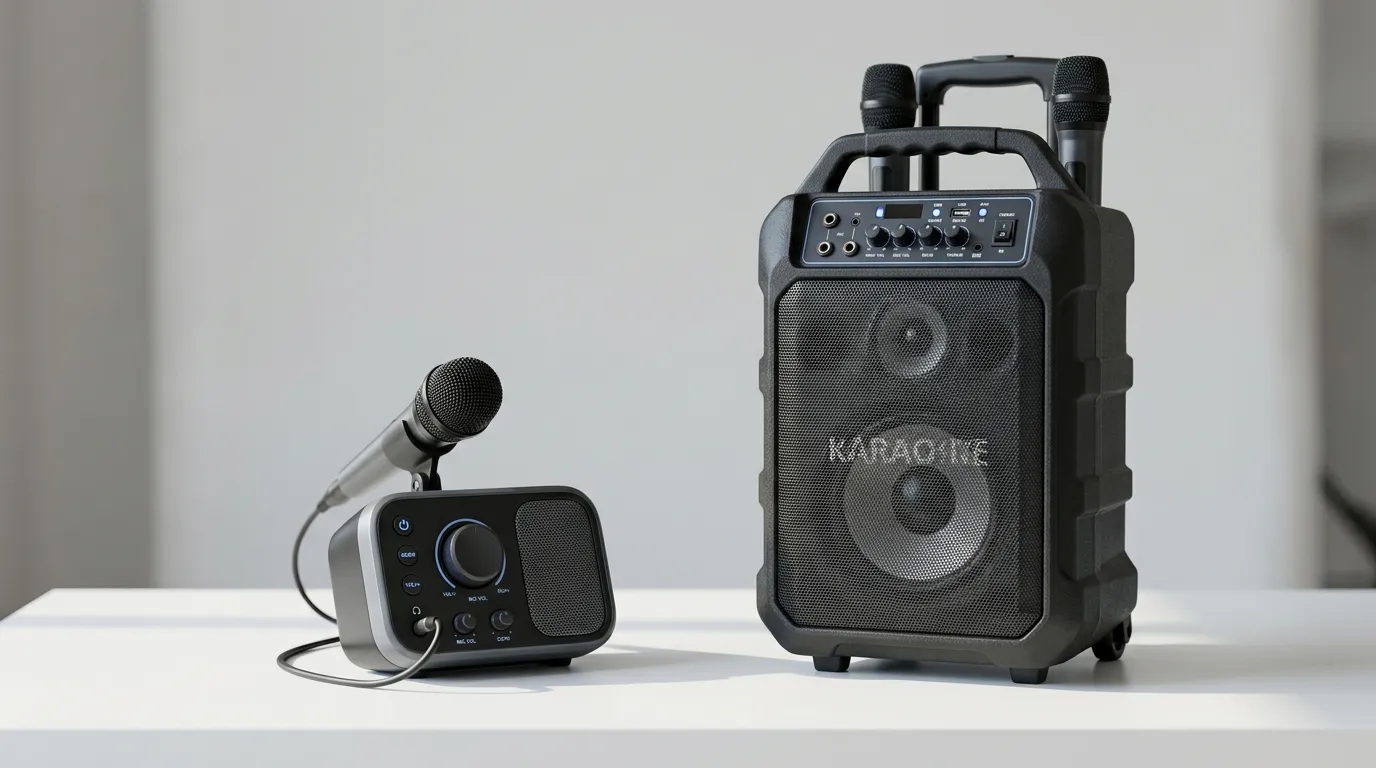
The 3 physical thresholds that define the mini category are weight (under 5 lbs), footprint (typically under 8 inches in any single dimension), and speaker driver size (2–3 inch driver vs 4–6.5 inch drivers in portable machines). All 3 usually align a machine under 8 inches almost always weighs under 5 lbs and runs a small driver.
Mini karaoke machines are not toy microphones. A toy mic amplifies the voice through a small earphone-style speaker audible only to the person holding it. A mini karaoke machine has genuine audio output (5W minimum) through a real speaker driver both the performer and anyone nearby hear the backing track and vocal together.
The 5 lb threshold is the consistent boundary used across this site’s karaoke machine types taxonomy. A machine marketed as ‘ultra-compact’ but weighing 5.5 lbs is a portable machine, not mini.
Mini vs Portable: What’s the Actual Difference?
Mini and portable karaoke machines differ across 3 measurable attributes: weight, output power, and intended use distance.
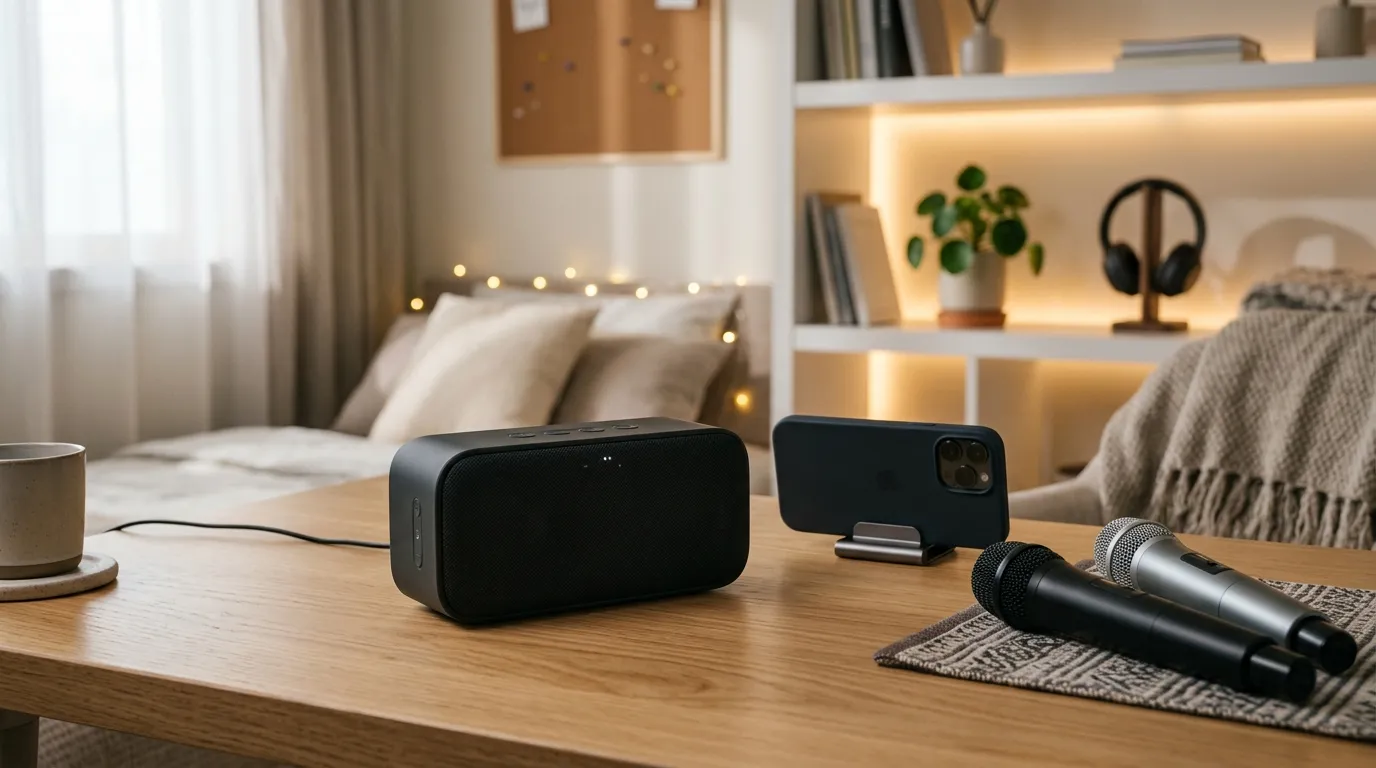
A mini machine is correct for single-listener desktop use or a 2-person close-range session. A portable karaoke machine is correct for group use or rooms larger than approximately 150 square feet.
| Attribute | Mini Karaoke Machine | Portable Karaoke Machine |
|---|---|---|
| Weight | Under 5 lbs | 5–22 lbs |
| Output power | 5–20W | 10–80W |
| Driver size | 2–3 inches | 4–6.5 inches |
| Use distance | 2–4 feet | Room-filling |
| Battery life | 3–6 hours | 4–12 hours |
| Price range | $15–$60 | $50–$300+ |
| Best for | Desk, bedroom, personal use | Events, groups, outdoor |
At the boundary (4.8 lbs, 20W), use case decides classification desk and close-range personal use equals mini; room-filling group use equals portable.
Mini Karaoke Machine Reviews by Category
Best Budget Mini Karaoke Machine Under $25
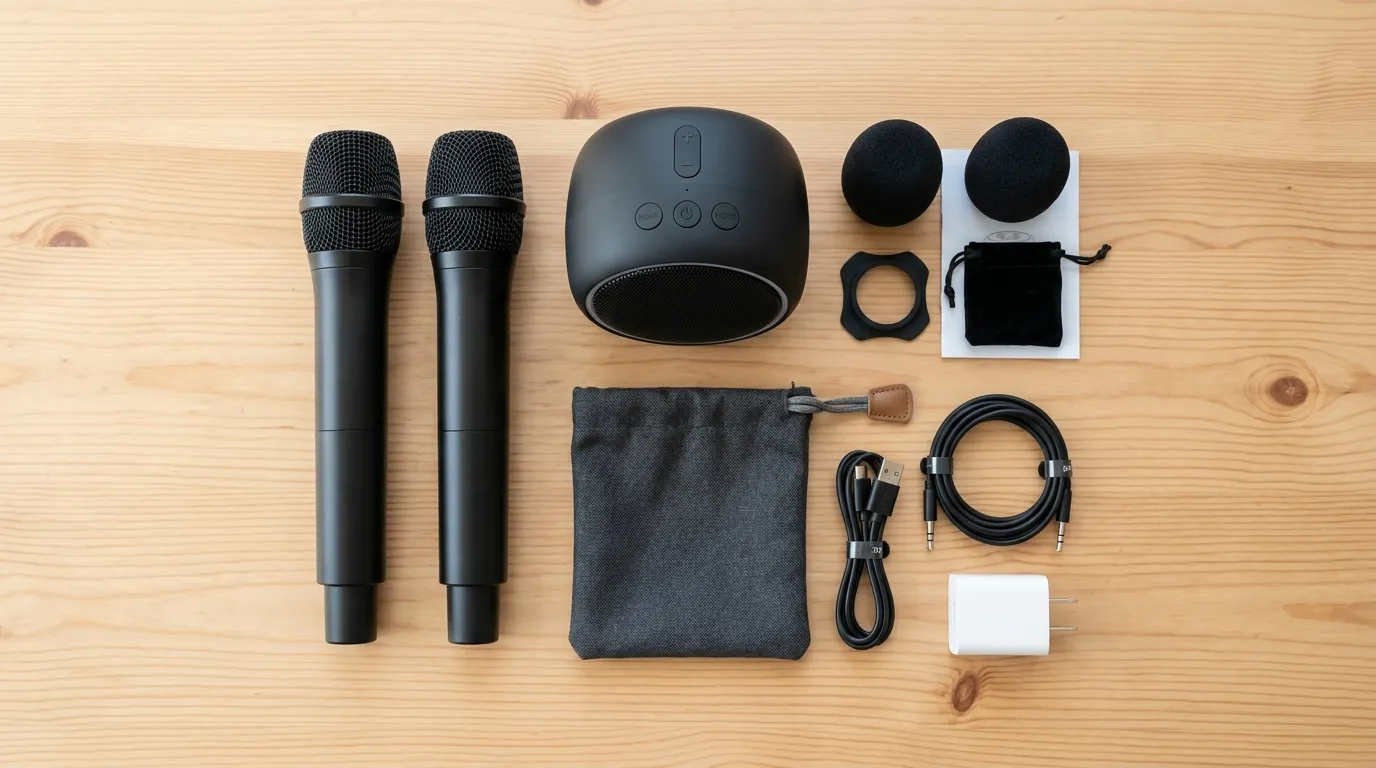
Who it’s for: Toddlers, very occasional desk use, first-time buyers testing the category.
The under-$25 tier is the entry point for the mini category. These machines run on 3–4 AA batteries, deliver 5–10W through a built-in fixed microphone, and have no audio input there’s no AUX port and no Bluetooth. Backing tracks play from a separate phone speaker nearby while the performer uses the machine’s mic input. The audio comes from 2 separate sources, which is the primary limitation.
Real-world use case: A 5-year-old performing along to nursery rhyme backing tracks in a bedroom, with the phone propped on a nightstand and the mini machine on the desk in front of them. At a 2–3 foot distance, the 5–10W output is more than adequate. For an adult wanting to practice performing seriously, this tier is insufficient step up to the mid-range or top tier.
✅ Pros
- Lowest entry cost ($15–$25)
- No setup required power on and perform
- No charging cables or charge cycles to manage
- Most durable configuration (no external cables, no wireless)
❌ Cons
- No audio input backing tracks must play from a separate device
- AA batteries add ongoing cost ($3–$6 per pack)
- 5–10W output limits use to very close range only
- No Bluetooth, no AUX, no connectivity of any kind
Best Mid-Range Mini Karaoke Machine $25–$40
Who it’s for: Solo performers, bedroom desk use, buyers who want one combined audio source.
The $25–$40 tier adds a 3.5mm AUX input and USB-rechargeable battery both meaningful upgrades. The AUX input lets you connect a phone’s headphone jack to the machine with a cable, routing the backing track through the machine’s speaker alongside the mic. The result is one unified audio experience rather than 2 competing sources.
Output improves to 10–15W, extending comfortable performing distance to the full 2–4 foot mini range. The rechargeable battery (rated for 3–6 hours, 300–500 charge cycles) eliminates ongoing AA battery costs at the expense of a degradation timeline.
Real-world use case: A teenager using the machine on a bedroom desk for evening performing sessions, phone connected via AUX cable, words displayed on the phone screen. The 10–15W output fills the desk area clearly without disturbing adjacent rooms. Sessions last 3–4 hours before recharging is needed.
✅ Pros
- AUX input unifies backing track and mic through one speaker
- USB-rechargeable eliminates AA battery costs
- 10–15W output suits close-range personal performing
- More mic separation from speaker for cleaner vocal audio
❌ Cons
- AUX cable required not wireless
- No Bluetooth phone must physically connect
- 300–500 charge cycle lifespan before battery degrades
- Still limited to desk or close-range use only
Best Top-Tier Mini Karaoke Machine $40–$60
Who it’s for: Bedroom performers who want wireless track access, 2-performer sessions, buyers wanting maximum mini-category functionality.
The $40–$60 tier is where the mini category becomes genuinely versatile. Bluetooth streaming, 15–20W output, USB-rechargeable battery, and often 2 wireless microphones combine to deliver a complete desktop karaoke experience without cables between the performer and the machine.
With Bluetooth, any karaoke app KaraFun ($9/month, 50,000+ licensed tracks), YouTube karaoke (free), or StarMaker (free tier) streams backing tracks directly to the machine’s speaker. The words display on the phone screen. Models like the Singing Machine Groove Mini, Singing Machine Mini Sparkle, YLL mini karaoke machine, and Kinglucky mini karaoke machine sit in this tier.
Real-world use case: Two performers in a dorm room or small bedroom, each holding a wireless auto-pairing microphone, with a phone paired via Bluetooth streaming a KaraFun backing track through the machine’s speaker. No cables between performers and the machine. Words on the phone screen. 15–20W output fills the desk area clearly at 3–4 feet.
✅ Pros
- Bluetooth wireless track streaming no AUX cable needed
- 2 wireless microphones on many models (YLL, Kinglucky)
- 15–20W output is the maximum available in the mini category
- USB-rechargeable battery (3–6 hours per charge)
- Supports KaraFun, YouTube karaoke, StarMaker and all compatible apps
❌ Cons
- Most expensive tier in the mini category ($40–$60)
- No built-in track library requires a phone and app for every session
- 2.4GHz wireless mics have limited range vs UHF systems in portable machines
- Above $60 you exit the mini category entirely pay more and get a portable
Popular Mini Karaoke Machine Models and Brands
Several mini karaoke machine models appear consistently across category searches:
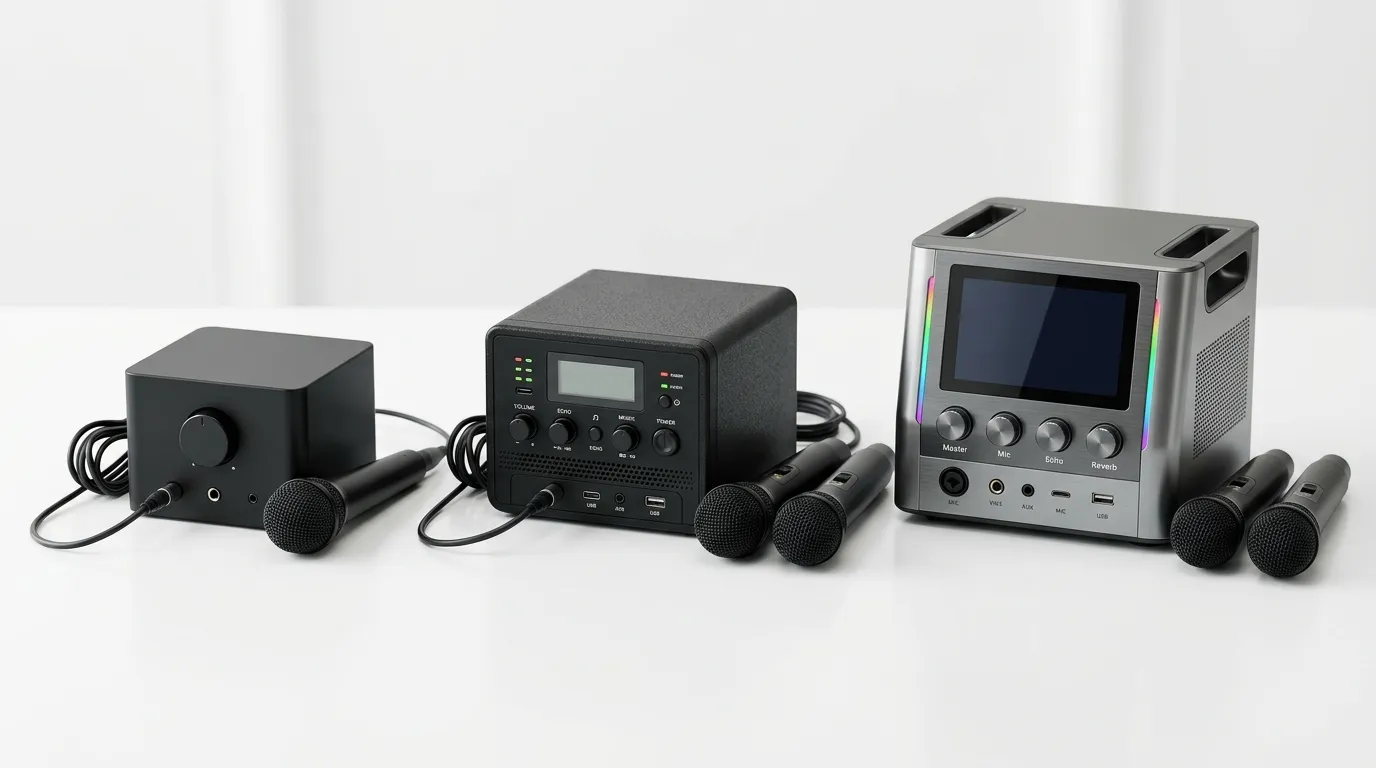
Singing Machine Groove Mini Bluetooth-enabled, wired mic input, $40–$55 tier. The most-searched specific mini model in the US market. Manufactured by Singing Machine, the largest consumer karaoke brand in the US.
Singing Machine Mini Sparkle Similar Bluetooth portable mini in the same tier, available in pink and standard colourways. Popular with buyers seeking a colourful gift.
YLL mini karaoke machine 2-mic wireless bundle in the $35–$55 range. One of the few mini machines including 2 wireless auto-pairing microphones as standard. Commonly searched with instructions queries (“YLL mini karaoke machine instructions”).
Kinglucky mini karaoke machine 2-mic Bluetooth bundle, similar tier to YLL. Compact wireless-mic machine at $35–$55.
JYX mini karaoke machine Compact Bluetooth speaker with mic input, $30–$50 range. The mini-format version of the JYX brand.
Other models appearing in category search: Groove mini karaoke machine, Iroo mini karaoke machine, Bauhn mini karaoke machine (Australia market), Notoka, Goopow, Syncfun, and Monster mini karaoke machines all Bluetooth + wireless mic bundles in the $30–$60 functional tier.
For ranked reviews of specific models, the best mini karaoke machine review covers the top-performing options at each price point.
Buying Guide: Technical Specifications Explained Simply
Audio Output (Wattage)
5–10W: Fills a 2–3 foot desktop area only. Cannot compete with room noise. 10–15W: Comfortable at the full 2–4 foot mini use distance. Small bedroom or desk corner. 15–20W: Maximum available in the mini category. Cleaner headroom, less distortion at higher volumes.
None of these wattage levels fill a room. At 20W and 10 feet, volume drops to approximately 60–65dB quieter than a normal conversation. Mini machines are for close-range personal use, not room-filling audio.
Connectivity Options
| Connection | Tier | What It Does |
|---|---|---|
| None | Under $25 | No phone audio separate device plays backing track |
| 3.5mm AUX | $25–$40 | Wired phone connection one unified audio source |
| Bluetooth 5.0 | $40–$60 | Wireless phone streaming no cable, full app access |
No mini machine in the $15–$60 tier includes HDMI or USB audio input. These connections appear only in full-size home machines.
Track Sources: How You Get Words on Screen
Mini karaoke machines do not display words on a built-in screen. All words display on the connected phone screen via the karaoke app. The 3 practical track access routes:
- KaraFun ($9/month) 50,000+ licensed tracks, real-time synced words, best catalogue at this scale
- YouTube karaoke (free) large catalogue, words displayed in video, no subscription required
- StarMaker / Smule (free tier) smaller catalogue, social performing features
No mini machine in the $15–$60 range has a meaningful built-in track library. The few models advertising pre-loaded tracks typically include 10–30 nursery rhyme tracks aimed at toddlers.
Portability: Weight, Handles and Battery
All mini machines (under 5 lbs) are genuinely hand-portable in a single carry. Most fit in a medium bag without a dedicated case. Battery life is 3–6 hours depending on tier and volume level.
AA battery models (under $25): No charging required. Replace batteries and the machine works indefinitely. Alkaline AAs degrade in cold environments rechargeable models are more reliable in cooler outdoor temperatures.
USB-rechargeable models ($25–$60): Charge via USB-C or Micro-USB. Rated for 300–500 full charge cycles (approximately 1–2 years at daily charging) before degrading to ~80% capacity.
Mini Karaoke Machines and Children: The Overlap, Not the Same Category
Mini and for kids are 2 separate attribute categories a mini machine is not automatically child-safe, and a kids-safe machine is not automatically mini-sized.
Mini machines are not required to include a volume limiter (the 85dB WHO child hearing safety threshold) unless specifically marketed for children. A 20W mini machine at maximum volume measures approximately 75–80dB at 3 feet within safe limits at that distance, but some budget models driven at very close range by small children can exceed safe levels.
For any child under 8, confirm 3 things before purchasing: (1) a stated maximum dB rating at a given distance; (2) a volume limiter if available; (3) no small detachable parts (choking risk under age 3).
For age-specific child-safe recommendations, the best karaoke machine for kids review covers machines built with child safety as the primary design criterion.
How to Use a Mini Karaoke Machine: Setup, Phone Connection and Echo Control
Setting up any mini karaoke machine takes under 5 minutes. Three steps apply regardless of model:
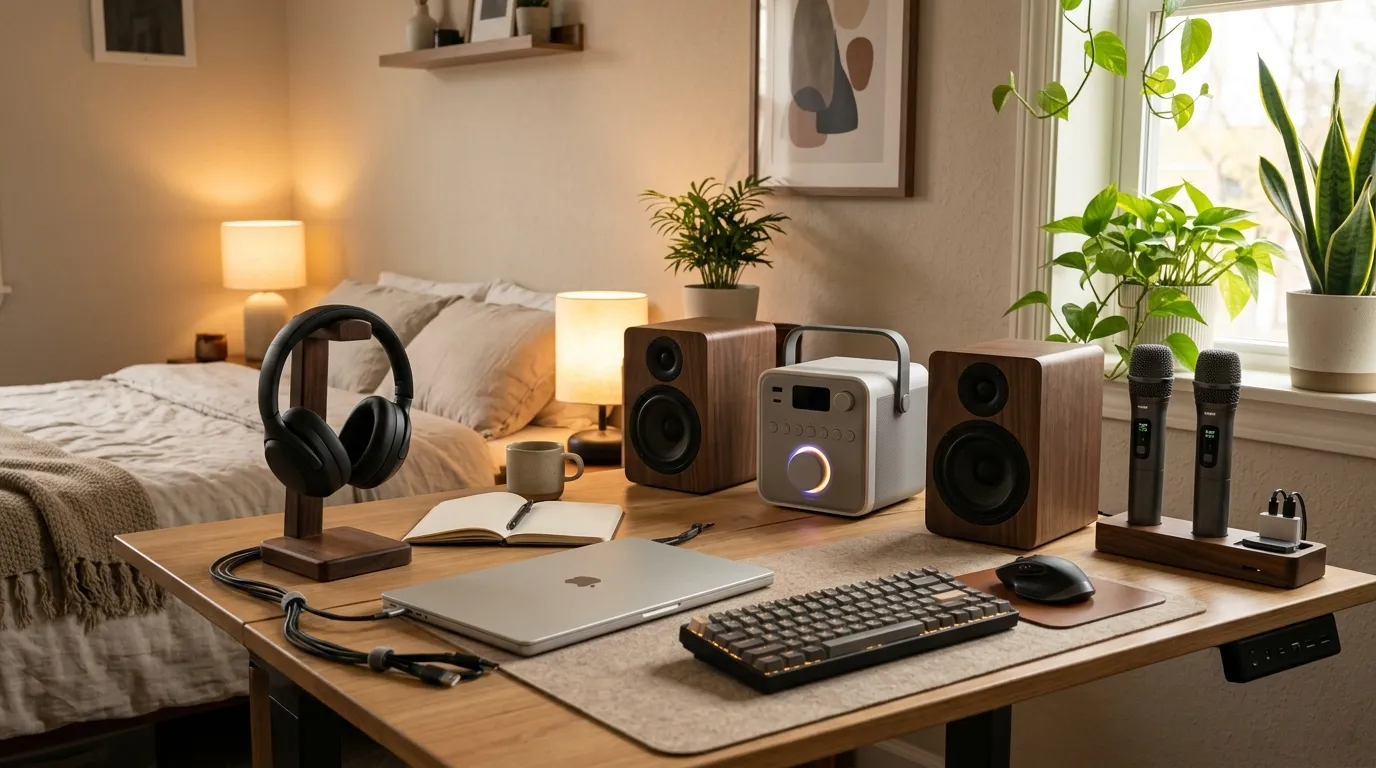
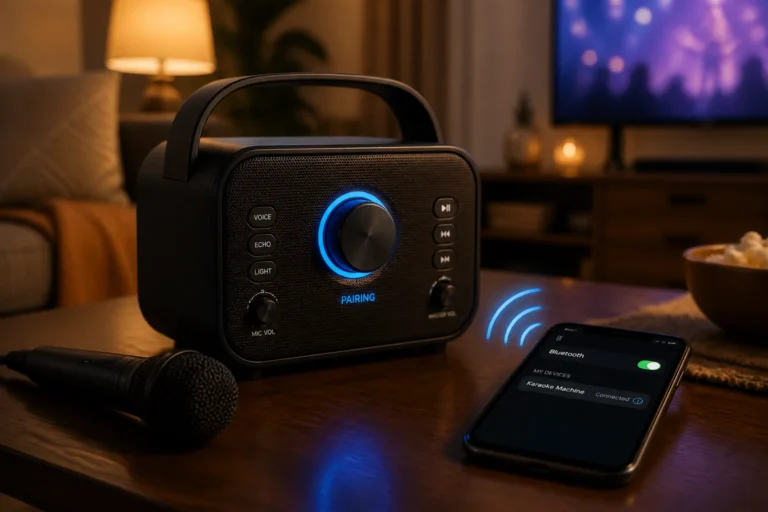
Step 1 Connect your phone. Bluetooth models ($40–$60): hold the Bluetooth button until the indicator flashes, then select the machine from your phone’s Bluetooth settings. AUX models ($25–$40): connect a 3.5mm cable between the phone’s headphone jack and the machine’s AUX input. Entry models (under $25): open your karaoke app on the phone and position it near the machine.
Step 2 Open a karaoke app and play a backing track. KaraFun, YouTube karaoke, and StarMaker are the 3 most practical options. The audio routes to the machine’s speaker via Bluetooth or AUX. Words display on the phone screen.
Step 3 Adjust echo and volume. Set microphone volume and echo depth using the physical dials. Start at 30–40% echo depth for indoor desktop use. To turn echo off, rotate the echo dial fully counter-clockwise to 0. Some performers prefer no echo during practice sessions where accurate pitch feedback matters.
If the machine doesn’t appear in your phone’s Bluetooth list, hold the Bluetooth button for 3–5 seconds to force re-pairing mode the machine is likely still paired to a previous device.
Voice Effects at Mini Scale: What Echo and Reverb Sound Like
Most mini machines in the $25–$60 tier include basic echo via a simple analog circuit a short trailing repetition behind the vocal, not the rich processing of a professional amplifier.
At 10W through a 2-inch driver, echo adds stage presence and confidence to the performing experience. It’s functional and appropriate for the price point. Reverb appears mainly in the $40–$60 tier on some models it requires more DSP than simple echo delay.
Mini karaoke machines with voice changer functionality use DSP to apply pitch-up or pitch-down modulation to the live mic signal in real time creating cartoon, robot, or alien voice effects. This is a different audio path from standard echo. Voice changers are aimed primarily at children aged 5–12 as an entertainment feature, not as a performing-quality enhancement.
Key control (pitch shifting the backing track) is almost entirely absent from the mini category it requires dedicated DSP circuitry that adds $50–$100 to machine cost. Use your karaoke app’s built-in key control setting instead.
When a Mini Karaoke Machine Is the Wrong Choice
A mini karaoke machine is the wrong choice for 3 use cases: groups of more than 2–3 people, rooms larger than 150 square feet, and any outdoor use.
One clarification first: mini karaoke machines for adults are a legitimate use case for solo or duo desktop performing. The size category does not imply an age restriction. The wrong-choice scenarios apply to adults and children equally.
Groups of 3 or more: At 5–20W, the output ceiling is too low to project across a room to multiple listeners. Someone always strains to hear, or the machine maxes out and distorts.
Rooms larger than 150 sq ft: A 20W mini machine drops to approximately 60–65dB at 10 feet quieter than a normal conversation. In a standard living room of 200–300 sq ft, it is inaudible at the far end.
Outdoor use: Mini machines are not weather-rated and their output is overwhelmed by open-air ambient noise. Even on a calm day, a 20W mini machine at 3 feet produces less usable volume than a phone speaker at full volume.
For groups, larger rooms, or outdoor events, start at the portable karaoke machine category machines there start at 40W and are designed for these conditions. For a full home karaoke experience, the best karaoke machine review covers full-scale machines across every use case.
What a Mini Karaoke Machine Costs and What You Get
| Tier | Output | Mic | Battery | Bluetooth | Track Access | Best For |
|---|---|---|---|---|---|---|
| Under $25 | 5–10W | Built-in fixed | AA batteries | No | None | Toddler desk play, basic gift |
| $25–$40 | 10–15W | 1× wired 3.5mm | USB-rechargeable | No | 3.5mm AUX from phone | Solo bedroom or desk use |
| $40–$60 | 15–20W | 1–2× wired or wireless | USB-rechargeable | Yes | Bluetooth streaming | Bedroom + app-based karaoke |
Above $60, machines typically exceed the 5 lb mini threshold and are correctly classified as portable. The $40–$60 Bluetooth tier is the most versatile within the mini category Bluetooth opens access to every karaoke app without a cable, which is the single biggest functional improvement available in this size class.
For specific model recommendations across all 3 tiers, the best mini karaoke machine review ranks the top options at each price point with full spec detail.
Frequently Asked Questions
What counts as a mini karaoke machine?
A mini karaoke machine is any unit weighing under 5 lbs with a desktop or handheld form factor, delivering 5–20W of output for close-range use at 2–4 feet. Machines between 5 and 10 lbs are classified as portable regardless of marketing language. The weight threshold is the primary defining attribute physical dimensions (under 8 inches), driver size (2–3 inches), and price range ($15–$60) are secondary indicators that typically align with the weight classification.
Is a mini karaoke machine good for an event?
No. At 5–20W output designed for a 2–4 foot listening distance, mini karaoke machines are not suitable for room-filling event volume. At 10 feet, a 20W mini machine drops to approximately 60–65dB below comfortable listening level in a room with ambient conversation. For groups of more than 2–3 people or rooms larger than 150 square feet, a portable machine (40W+) is the correct choice.
Does a mini karaoke machine come with a microphone?
Most mini karaoke machines include either a built-in fixed microphone integrated into the machine body, or a single wired 3.5mm/6.35mm mic input accepting a standard handheld mic. Built-in mics are standard under $25; wired mic inputs appear from $25 upward. Models like the YLL and Kinglucky include 2 wireless auto-pairing microphones in the $40–$60 tier.
Is a mini karaoke machine safe for a toddler?
It depends on the specific machine, not the size category. Mini and safe for kids are 2 separate attributes a mini machine is not automatically equipped with an 85dB WHO volume limiter. At maximum volume, a 20W mini machine measures approximately 75–80dB at 3 feet within safe limits at that distance. For a child under 8, confirm a maximum dB rating, a volume limiter, and no small detachable parts before purchasing.
How much does a mini karaoke machine cost?
Mini karaoke machines range from $15 to $60 across 3 price bands: under $25 (AA battery, built-in mic, 5–10W), $25–$40 (USB-rechargeable, wired mic input, 10–15W), and $40–$60 (USB-rechargeable, Bluetooth streaming, 15–20W). Above $60, a machine typically exceeds the 5 lb mini threshold and is classified as portable. The $40–$60 tier adds Bluetooth streaming the most significant feature upgrade in the mini category.
What is the difference between a mini and a portable karaoke machine?
Mini machines weigh under 5 lbs, deliver 5–20W through a 2–3 inch driver, and suit 2–4 foot desktop use at $15–$60. Portable machines weigh 5–22 lbs, deliver 10–80W through larger drivers, and are designed for room-filling or outdoor group use at $50–$300. A mini machine cannot substitute for a portable at an event, outdoor gathering, or in any room larger than approximately 150 square feet.
Do mini karaoke machines use AA batteries or rechargeable?
Both exist. Under-$25 models typically use 3–4 AA batteries with ongoing replacement cost of $3–$6 per pack. Models from $25 to $60 use an internal USB-rechargeable cell rated for 300–500 full charge cycles before degrading to ~80% capacity. Check the product listing for power source before purchasing if ongoing cost or convenience is a deciding factor.
Can a mini karaoke machine connect to Bluetooth?
Some can. Bluetooth streaming appears only in the $40–$60 mini price band, enabling wireless track playback from a connected phone and access to apps including KaraFun and YouTube karaoke. Machines under $25 have no Bluetooth and no external audio input beyond the mic. Machines in the $25–$40 tier offer a 3.5mm AUX input wired connection, not wireless Bluetooth pairing.