All-in-One Karaoke Machine: What “All-in-One” Actually Means
An all-in-one karaoke machine combines the main karaoke hardware inside one primary unit. It normally handles track input, microphone input, internal audio mixing, amplification, and speaker output. A separate mixer, power amplifier, or powered speaker is not required for basic operation.
Table of Contents
The term describes system integration, not a fixed feature package. WiFi, a touchscreen, battery power, wireless microphones, or internal storage can increase independence, but none is required. The essential distinction is whether the core audio stages operate inside the primary unit.
What Makes a Karaoke Machine All-in-One?
A complete karaoke audio chain requires a track source, microphone path, mixing stage, amplification, and speaker output. A component setup can distribute these functions across several devices. An all-in-one system combines the essential stages within one enclosure.
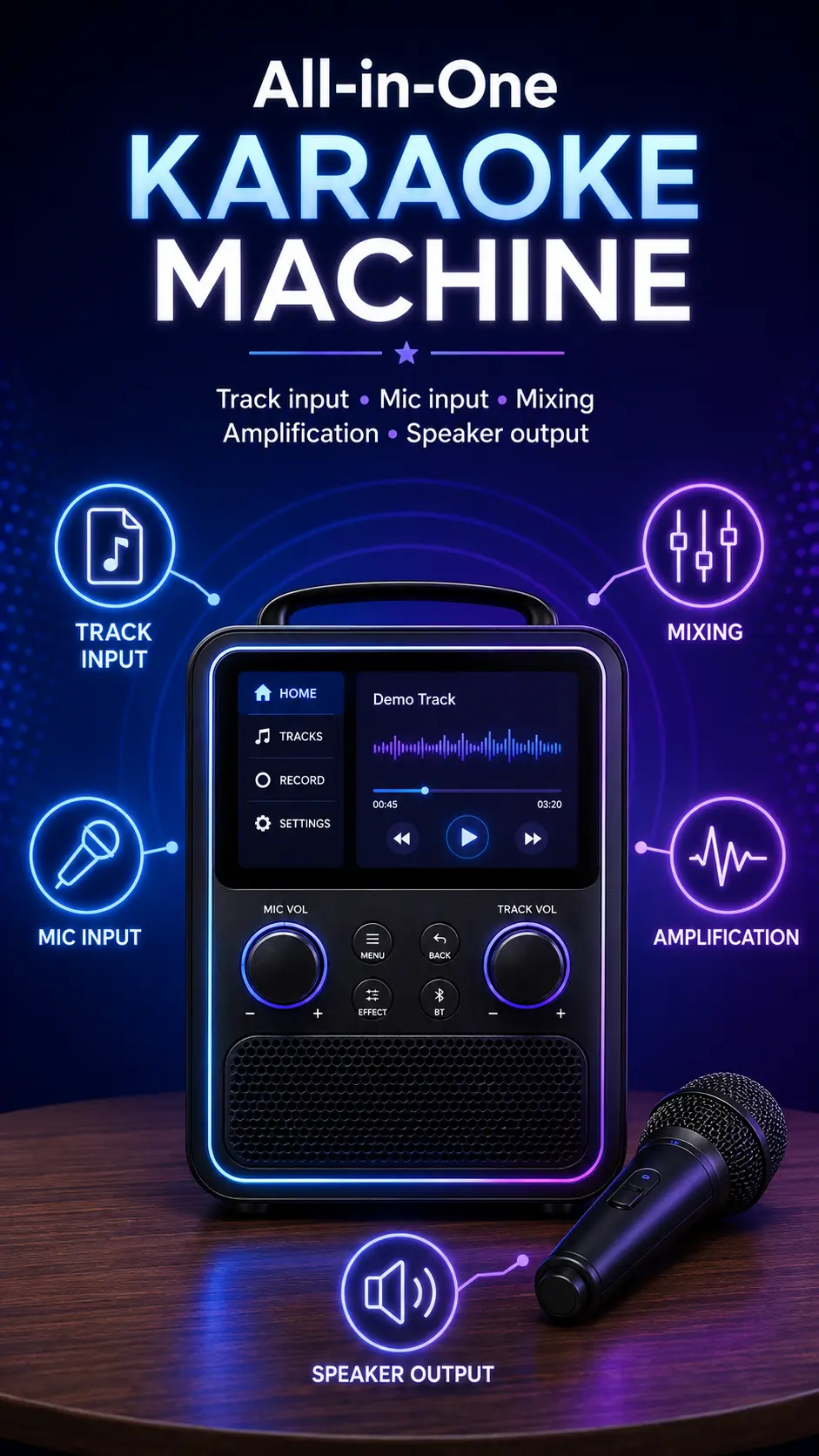
The basic path is track source → microphone input → mixing → amplification → speaker output. The main unit should complete this path without requiring a separate mixer or amplifier. It should also provide its own speaker output during normal operation.
External devices can still provide lyrics, track access, storage, or network connectivity. A phone, tablet, television, or USB device does not automatically make the system component-based. The classification depends on where the essential audio processing takes place.
| Function | Required for All-in-One? | Purpose |
|---|---|---|
| Track input or playback | Yes | Provides the backing track |
| Microphone input | Yes | Receives the live vocal signal |
| Internal mixer | Yes | Combines microphone and track signals |
| Internal amplifier | Yes | Powers the output stage |
| Built-in speaker | Yes | Produces the final audio output |
| Built-in screen | No | Displays lyrics or controls |
| Bluetooth | No | Provides wireless audio input |
| WiFi | No | Provides network access |
| Rechargeable battery | No | Allows operation away from mains power |
| Wireless microphones | No | Removes the microphone cable |
Built-In Speaker
An all-in-one karaoke machine includes its own speaker system for normal operation. The speaker receives the final signal after the microphone input and backing track have been combined and amplified. A separate powered speaker should not be necessary for basic use.
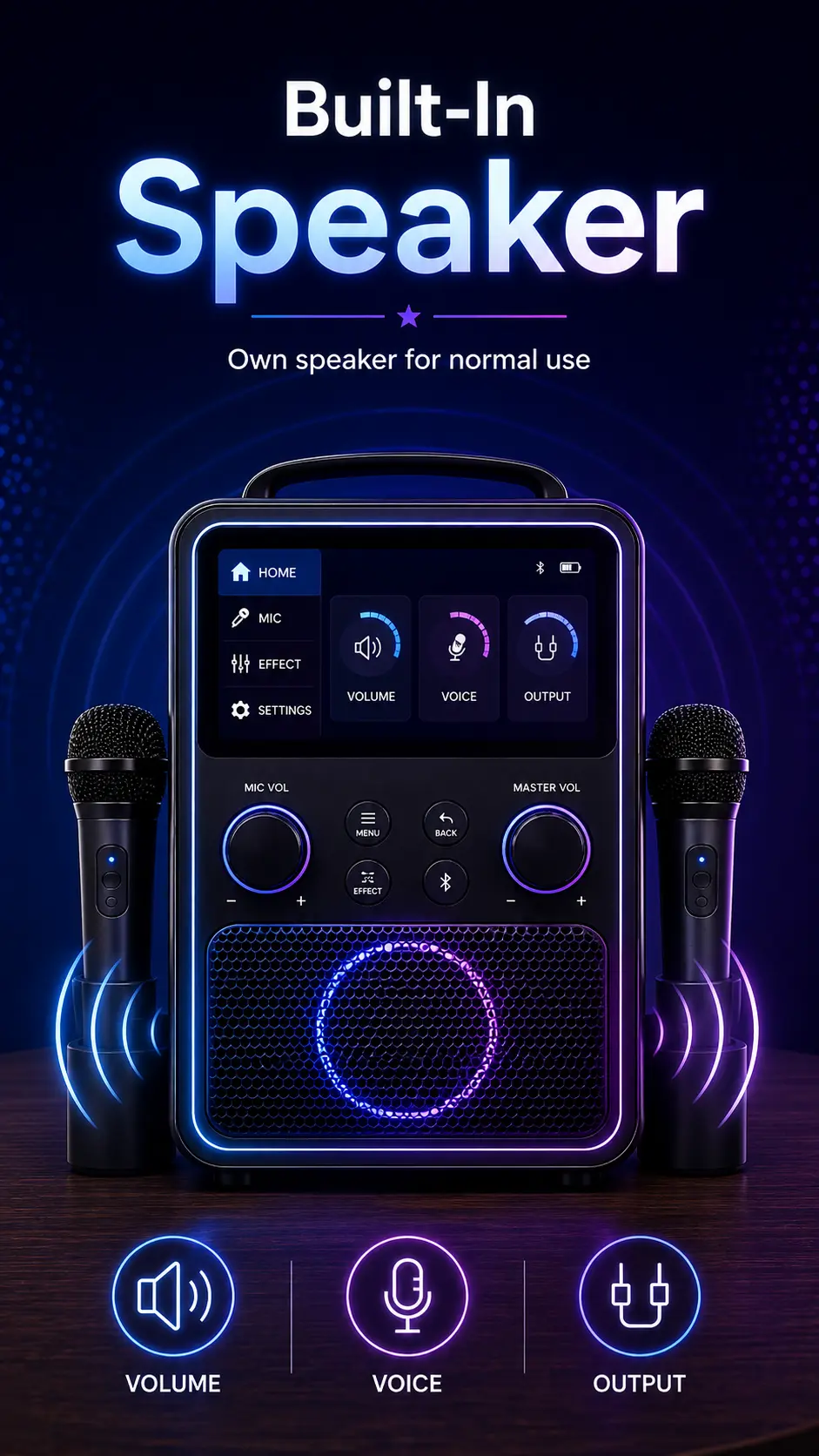
Speaker size and output capability vary considerably between systems. Compact units may prioritize reduced dimensions and easier transport, while larger enclosures can support different driver arrangements. The all-in-one label does not establish a minimum speaker size, output level, or driver configuration.
A standalone mixer does not qualify as a complete all-in-one system by itself. It can combine several audio inputs but may still require external amplification and speakers. An integrated karaoke machine contains those additional stages within the primary unit.
Internal Amplification
The internal speaker requires amplification before it can produce usable output. An all-in-one karaoke machine contains that amplifier inside its main enclosure rather than relying on a separate component. This reduces the number of devices and physical connections required.
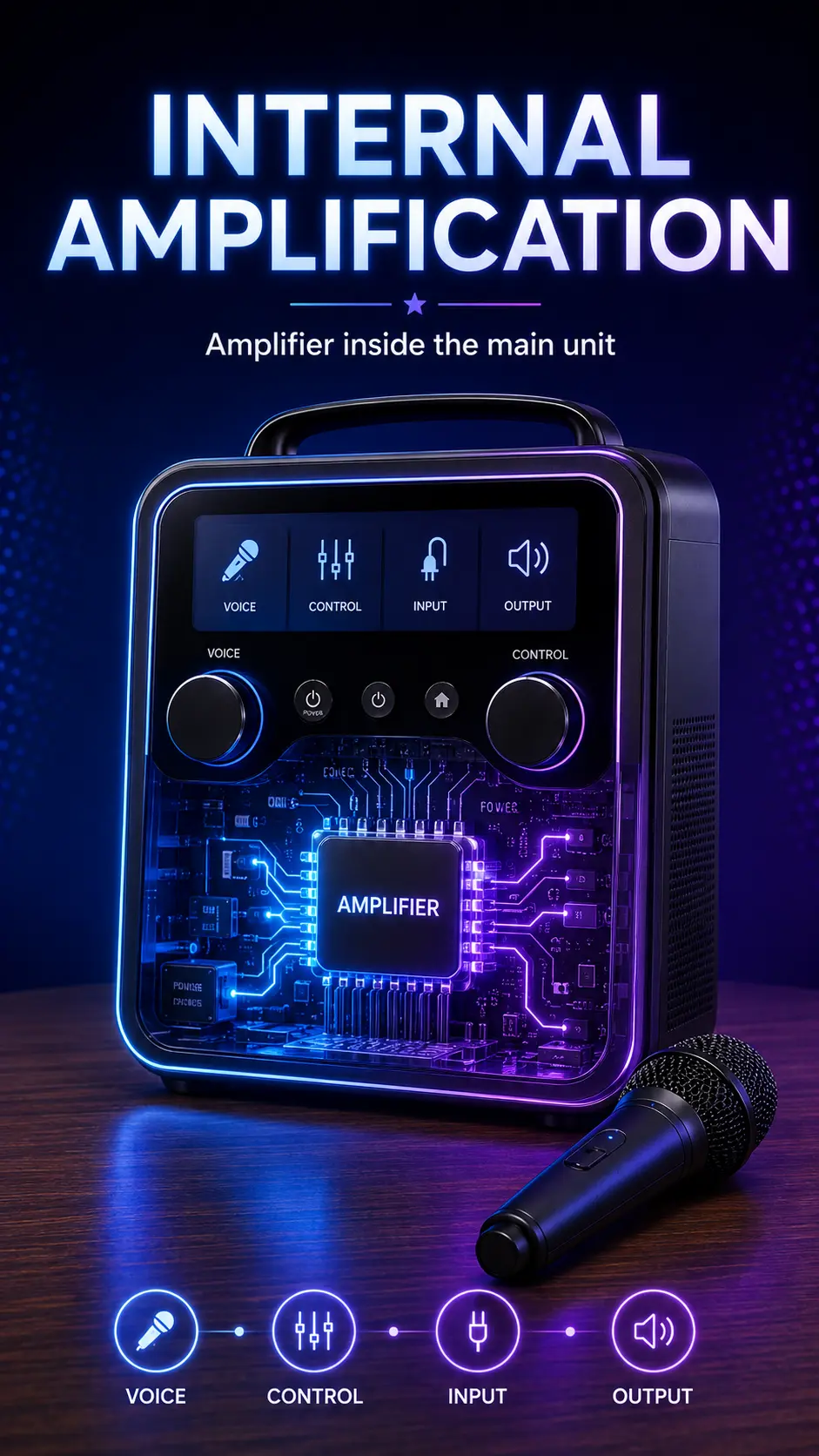
Integrated amplification does not guarantee a particular output level. Different machines can use different amplifier designs, speaker configurations, and power ratings. Peak output and continuous output are separate measurements and should not be treated as interchangeable specifications.
The defining requirement is that basic operation does not depend on an external amplifier. If another amplifier must be connected before the signal reaches a speaker, part of the essential audio chain remains outside the main unit.
Microphone Input
An all-in-one karaoke system must provide a way to receive at least one microphone signal. This can use a wired input, an integrated wireless receiver, or both. For step-by-step guidance on setting up vocal channels, our karaoke machine microphone setup guide covers balancing vocal volume and preventing feedback.
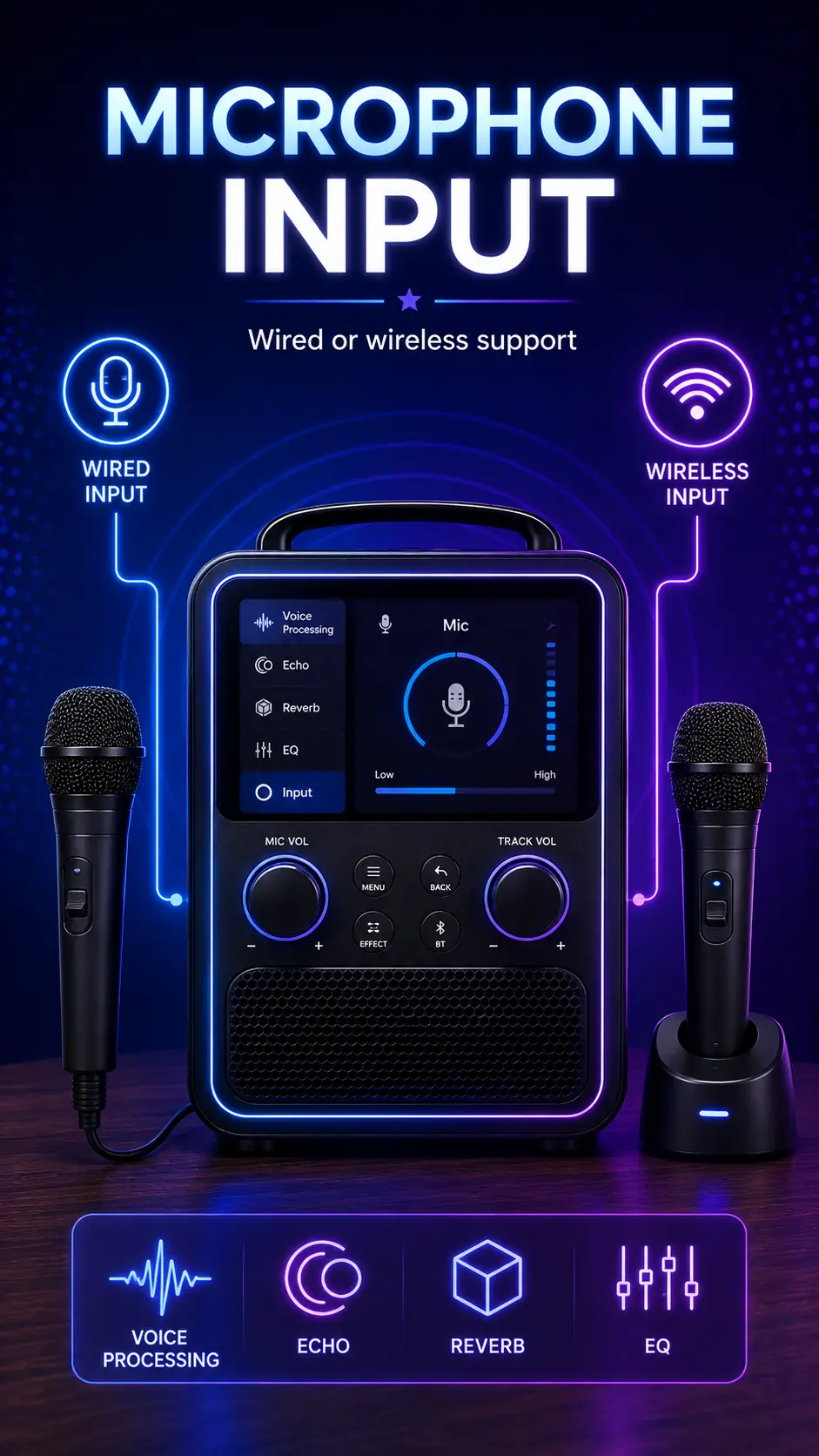
Some machines support one microphone, while others support two or more at the same time. Microphone capacity is a separate specification from the all-in-one classification. A system supporting a single microphone can still satisfy the core integration requirements.
Common microphone configurations include:
- One wired microphone input
- Two wired microphone inputs
- One integrated wireless receiver
- Dual wireless microphone receivers
- Combined wired and wireless support
- Additional microphone inputs for expansion
Wireless support also varies between individual machines. Some packages include compatible wireless microphones, while others provide only inputs or receivers. Wireless frequency, pairing method, charging system, and compatibility should therefore be assessed separately.
Internal Audio Mixing
The microphone signal and backing track must be combined before the final output reaches the speaker. An internal mixer performs this function inside the primary enclosure. This removes the need for a separate external mixing console during basic operation.
Basic systems may provide separate level controls for the microphone and backing track. More advanced machines can add echo, reverb, EQ, key adjustment, or other vocal-processing controls. These functions increase control but do not define the category.
The essential requirement is that both audio paths are combined inside the main unit. If an external mixer is required during ordinary use, an essential stage of the system remains separate. That arrangement is better described as component-based.
Track Input or Playback
An all-in-one machine also needs a method for receiving or playing a backing track. Common methods include Bluetooth, USB, AUX, internal storage, disc playback, network access, or onboard applications. The source can be internal or external.
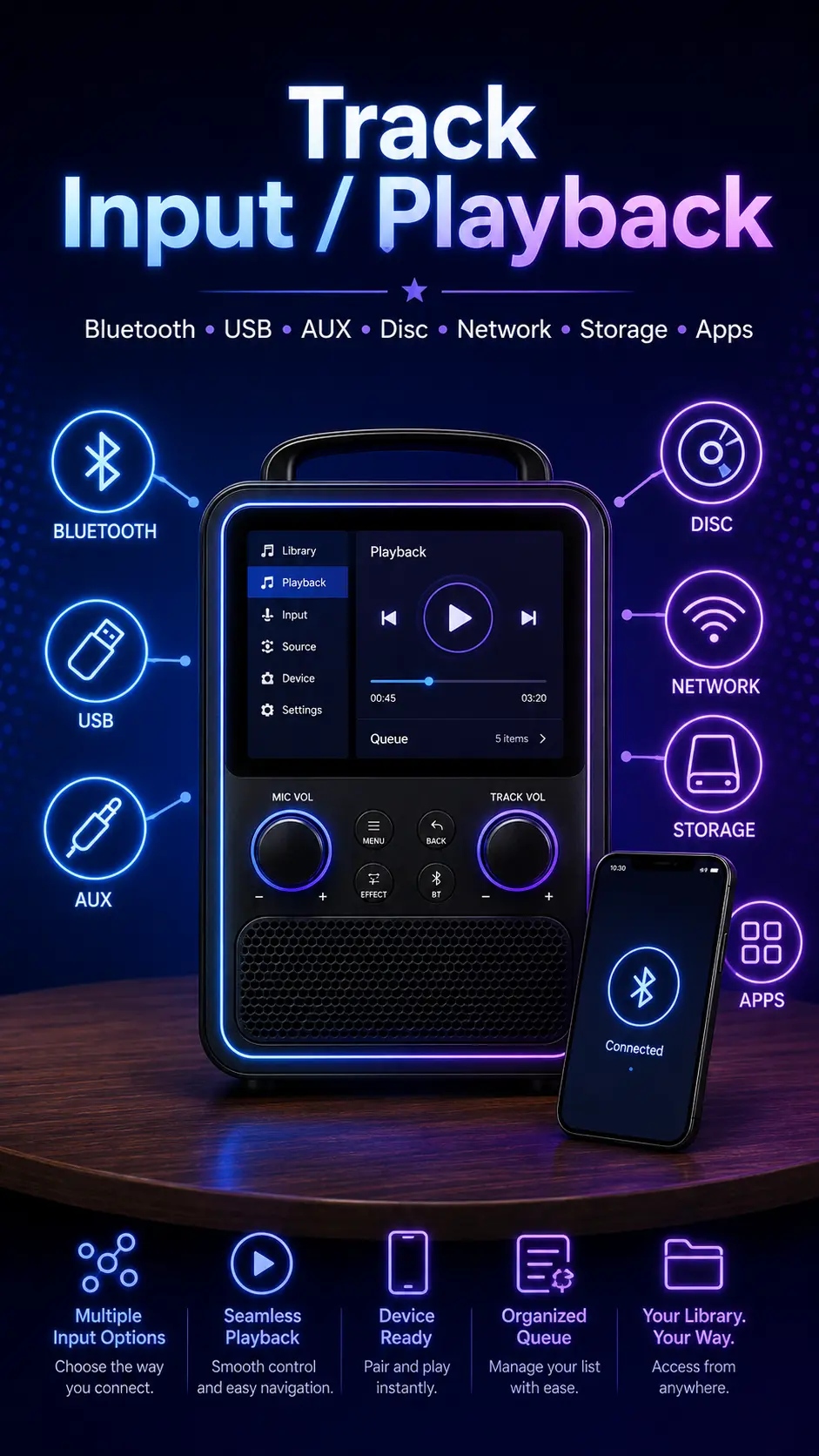
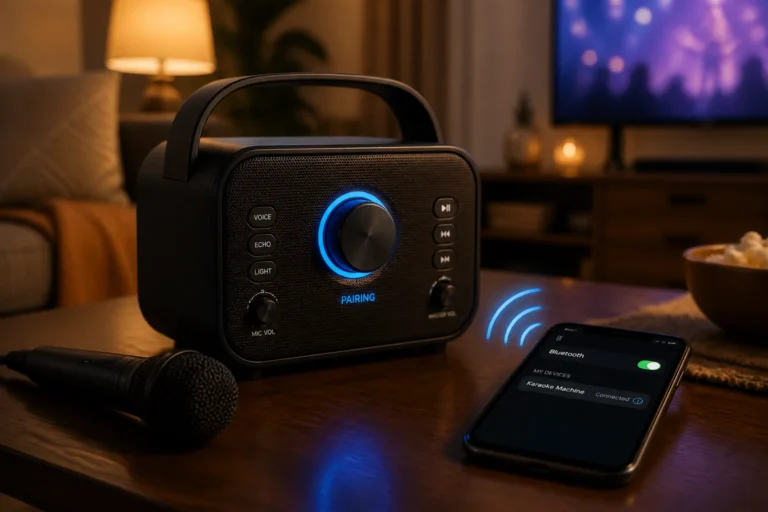
A phone can transmit a backing track through Bluetooth while the karaoke machine handles the remaining audio stages. The main unit still processes the microphone, combines both signals, amplifies the result, and produces output through its internal speaker.
Some machines reduce external dependence through internal storage, network connectivity, or onboard applications. Others depend more heavily on a phone, tablet, USB device, or another source. Both arrangements can still meet the basic all-in-one definition.
Does an All-in-One Karaoke Machine Need a Screen?
No. A built-in screen is not required for an all-in-one karaoke machine. A screenless system can still integrate the speaker, amplifier, microphone path, mixing stage, and track input while using another device for visual information.
A screen-equipped machine adds lyric display, navigation, or control functions directly to the primary unit. This reduces dependence on another display but does not create the underlying audio integration. The screen is an additional feature rather than a core requirement.
Two systems can therefore both qualify as all-in-one even when only one includes a display. The difference is the level of supporting functionality contained inside the enclosure. Audio integration remains the central classification criterion.
All-in-One Karaoke Machine With a Screen
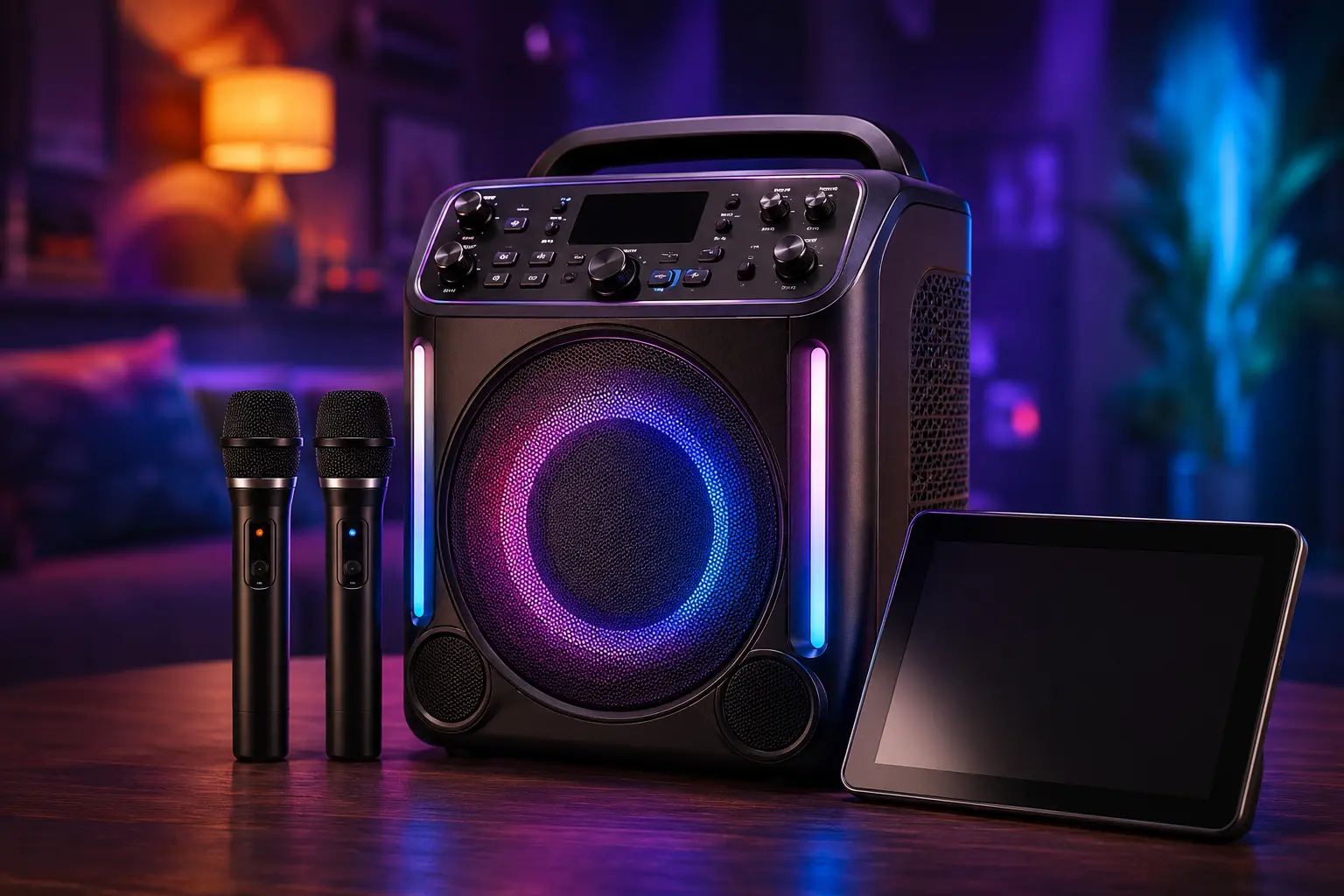
A screen-equipped system can display lyrics, controls, and navigation information directly on the machine. Some models use a basic display, while others provide a touchscreen interface. For more details on touchscreen types, see our guide to a karaoke machine with a built-in screen. Additional features may include WiFi, internal storage, or onboard applications.
A built-in display does not guarantee complete independence from external services or devices. The system may still require WiFi, an account, external storage, or another source for track access. Display integration and source independence are separate characteristics.
Screen size also varies between machines. A larger display can increase visibility from a greater distance, while a smaller display can reduce enclosure size and electrical demand. Screen dimensions do not determine whether the system is all-in-one.
All-in-One Karaoke Machine Without a Screen
A screenless all-in-one system keeps the essential audio stages inside the main unit while using another device for visual information. A phone, tablet, or monitor can provide the display, or you can check how to connect a karaoke machine to a TV to show lyrics on a larger screen while the core processing remains internal.
This arrangement can reduce hardware complexity, overall dimensions, weight, and power requirements. It can also suit rooms where a television or other display is already available. The absence of an onboard screen does not make the audio system incomplete.
The decisive factor is whether microphone processing, mixing, amplification, and speaker output occur inside the primary unit. If those stages remain integrated, the machine can still be classified as all-in-one. Display integration is a separate attribute.
Does All-in-One Mean Tracks Are Built In?
No. The all-in-one label does not guarantee that karaoke tracks are stored inside the machine. Systems can use Bluetooth, USB storage, discs, internal memory, network access, or onboard applications to receive or access backing tracks.
A machine can contain the complete audio chain while depending on an external device for its track source. A connected phone can provide the backing track while the main unit handles microphone processing, mixing, amplification, and speaker output.
The useful distinction is between hardware integration and track-source independence. These describe different aspects of operation. A system can be fully integrated at the audio level while still depending on an external source.
Does All-in-One Mean a Phone Is Not Required?
No. Some all-in-one karaoke systems still rely on a phone or tablet for track selection, lyrics, or Bluetooth transmission. The primary unit can remain fully integrated while the connected device performs those supporting functions.
More advanced machines may include internal controls, a touchscreen, WiFi, storage, or onboard applications. These features can reduce dependence on a connected mobile device. They represent greater device independence rather than a different core classification.
Audio integration and phone independence should therefore be evaluated separately. One machine may require a phone for selected functions, while another handles those functions internally. Both can still satisfy the all-in-one audio definition.
Does All-in-One Mean a TV Is Not Required?
Not always. A machine with an internal display can show lyrics without a television, while a screenless system may rely on a TV or another external display. The requirement depends on how visual information is handled.
A television normally remains outside the essential karaoke audio chain. Microphone processing, track mixing, amplification, and speaker output can all occur inside the primary unit while the television handles only visual output.
A setup designed to operate without a television needs another display method. That could be an onboard screen, phone, tablet, or compatible monitor. The all-in-one label alone does not identify the intended visual configuration.
Does All-in-One Mean Wireless Microphones Are Included?
No. An all-in-one karaoke machine can use wired microphones, wireless microphones, or both. The connection method affects setup and convenience but does not determine whether the essential audio hardware is integrated.
Some manufacturers include compatible wireless microphones, while others provide microphone inputs or wireless receivers without supplying every accessory. Package contents can therefore differ significantly between systems carrying the same all-in-one description.
The important requirement is that the primary unit can receive and process the microphone signal internally. Whether a particular microphone is included in the package is a separate product characteristic rather than part of the definition.
Does All-in-One Mean Battery Powered?
No. An all-in-one karaoke machine can operate entirely from mains power. Battery operation mainly affects portability and placement flexibility rather than whether the mixer, amplifier, microphone path, and speaker are integrated.
Some systems include rechargeable batteries for operation away from a wall outlet. Others are designed for continuous mains connection in a fixed location. Both configurations can satisfy the same basic all-in-one hardware definition.
Battery capacity should therefore be treated as an independent specification. Runtime, charging time, battery type, and operating behavior differ between models. None of those characteristics determines whether the machine belongs to the all-in-one category.
All-in-One vs Portable Karaoke Machine
All-in-one describes how the main karaoke functions are integrated, while portable describes how easily the machine can be moved. For setups where mobility is key, a dedicated portable karaoke machine offers battery power and handles, while a larger mains-powered system might stay in a fixed location.
A compact battery-powered machine may be both all-in-one and portable. A larger mains-powered system may also integrate every essential audio stage while remaining inconvenient to move. Weight, dimensions, handles, wheels, and battery operation affect portability.
The two terms should therefore be evaluated independently. Integration describes the internal system architecture, while portability describes practical mobility. Neither characteristic automatically guarantees the other.
All-in-One vs Bluetooth Karaoke Machine
Bluetooth describes a wireless connection method rather than a complete system architecture. It allows a compatible source device to transmit audio without a physical cable. A dedicated Bluetooth karaoke machine relies heavily on this standard to fetch tracks, but Bluetooth support alone does not define whether the core mixer and speaker integration exists.
A Bluetooth receiver without microphone processing, amplification, or speaker output provides only one part of the complete karaoke chain. An integrated machine may include Bluetooth alongside USB, AUX, internal storage, or other connection methods.
The distinction matters because Bluetooth appears on many types of audio hardware. It explains how a source connects, not how many essential functions are contained inside the enclosure. The complete audio chain must still be examined.
All-in-One vs Smart Karaoke Machine
A smart karaoke machine adds onboard computing or network-based functions to the primary unit. These can include WiFi, a touchscreen, internal applications, storage, account access, or advanced navigation. Such features extend beyond the basic all-in-one definition.
A simpler machine can still be all-in-one without smart functions. It only needs to integrate the track input, microphone path, mixing stage, amplification, and speaker output. Smart capability represents an additional digital layer.
The terms can overlap without being interchangeable. All-in-one describes integration of the main karaoke hardware, while smart describes onboard digital capability. A machine can satisfy the first definition without satisfying the second.
All-in-One vs Component Karaoke System
A component karaoke system separates major functions across several pieces of equipment. A typical configuration can use a separate source device, mixer, amplifier, microphones, speakers, and display. Each part performs a specific stage of the operating chain.
An all-in-one system combines more of those functions inside one primary enclosure. This reduces cabling, setup steps, storage requirements, and compatibility decisions. Fewer independent components must be connected before basic operation can begin.
A component system provides greater flexibility when individual speakers, mixers, amplifiers, or microphone systems need separate replacement or expansion. An integrated system instead prioritizes fewer devices and simpler setup. The main distinction is integration versus modularity.
What an All-in-One Karaoke Machine Does Not Guarantee
The all-in-one label does not guarantee a particular level of output, construction quality, or performance. It does not define microphone quality, speaker size, wireless range, display dimensions, battery capacity, or supported connection standards.
The term also does not guarantee HDMI, WiFi, Bluetooth, USB, internal storage, recording, vocal effects, or a touchscreen. Any of these features can be included, but none is universal across every integrated karaoke system.
Two machines using the same all-in-one description can therefore operate very differently. One may rely on several external devices, while another handles most supporting functions internally. Both can still integrate the complete core audio chain.
Levels of All-in-One Integration
A basic integrated system includes a speaker, amplifier, microphone input, internal mixer, and track input inside one primary enclosure. External devices may still provide lyrics or track selection while the essential audio chain remains internal.
A more integrated system can add wireless microphones, charging functions, battery power, and several input methods. These additions reduce the number of external accessories required and can make the machine easier to operate in different locations.
A higher level can add an onboard display, WiFi, internal applications, storage, and direct track-management controls. Each additional function reduces dependence on external hardware. The system becomes more self-contained without changing the core audio definition.
These levels are not formal industry standards. They provide a practical way to describe differences in integration between machines carrying the same broad label. The basic classification still depends on where the essential audio stages are located.
How to Identify a True All-in-One System
Start by confirming that the machine contains its own powered speaker and internal amplification. Then verify that it accepts a microphone signal and combines that input with a backing track internally. A separate mixer should not be required.
Next, confirm that the machine can receive or play a backing track through at least one supported method. Bluetooth, USB, AUX, internal storage, disc playback, or network access can all perform this source function.
If normal operation requires a separate mixer, amplifier, or powered speaker, the setup is not fully all-in-one. Those devices would be performing essential stages outside the main enclosure. The arrangement is better described as component-based.
Check External Dependencies
The phrase “all-in-one” can make a machine appear more independent than it actually is. A more accurate assessment identifies every external device, connection, or service required during normal operation. This shows the true level of system integration.
Check whether the machine requires a phone, tablet, television, external display, powered speaker, separate amplifier, or external mixer. Also identify whether WiFi, mains power, external storage, or another source is necessary for the intended configuration.
A machine with fewer required external components provides a higher degree of practical integration. A system with several dependencies can still qualify as all-in-one at the core audio level. Architecture and complete independence are related but separate concepts.
Is an All-in-One Karaoke Machine Easier to Set Up?
Usually. Fewer separate audio components need to be connected before operation, and much of the signal routing occurs internally. A basic setup may require only power, microphone activation, and a compatible backing-track source.
A modular setup can require separate connections between the source, mixer, amplifier, speakers, microphones, and display. Each additional component introduces another physical connection and another potential compatibility consideration. Integration reduces those relationships.
Setup difficulty can still vary between models. Wireless pairing, network access, display connections, or account configuration may add extra steps. All-in-one mainly simplifies the core audio hardware rather than guaranteeing instant setup.
Can an All-in-One Karaoke Machine Use External Speakers?
Some all-in-one machines provide an output for connection to an external audio system. Depending on the model, this may use line output, AUX output, or another supported interface. Other machines are designed mainly around the internal speaker.
Optional external-speaker support does not prevent a machine from being all-in-one. The important requirement is that basic operation can occur through the machine’s own amplifier and speaker. External output can simply provide additional expansion.
If an external powered speaker is mandatory before usable output can be produced, part of the essential chain remains outside the primary unit. That arrangement is closer to a modular or component system than a complete all-in-one machine.
Can an All-in-One System Use Additional Microphones?
Additional microphone support depends on the available physical inputs and the design of the internal wireless receiver. Some machines support only supplied or specifically paired microphones, while others provide additional wired or compatible wireless connections.
Compatibility can depend on connector type, wireless frequency, pairing method, and receiver design. A microphone compatible with one system may not operate with another. Proprietary wireless implementations can further restrict cross-system compatibility.
The number of supported microphones does not determine whether a machine is all-in-one. A system supporting only one microphone can still integrate the complete audio chain internally. Additional microphone capacity is a separate specification.
Is All-in-One the Same as Complete?
Not necessarily. All-in-one generally describes integration of the main hardware functions within one primary unit, while complete may describe the equipment or accessories included in a package. The two labels address different product characteristics.
An integrated machine may still depend on a phone for track access or use an external screen for lyrics. Those dependencies do not automatically change its core audio classification. A complete package may also contain several separate components.
The most reliable approach is to examine actual operating requirements. Identify which functions occur inside the main enclosure and which require external hardware or services. This provides a clearer description than either marketing label alone.
What Is the Definition of an All-in-One Karaoke Machine?
An all-in-one karaoke machine is a self-powered system that combines track input or playback, microphone input, internal audio mixing, amplification, and speaker output inside one primary unit. For buyers starting from scratch, our review of the best karaoke machine models highlights which packages deliver this full audio chain in a single purchase.
Additional features can include a display, WiFi, battery power, wireless microphones, storage, or onboard applications. These additions increase the degree of self-contained operation but are not required. Core audio integration remains the defining characteristic.
Frequently Asked Questions
What does all-in-one mean on a karaoke machine?
It means the main karaoke audio functions are integrated into one primary unit, including microphone input, mixing, amplification, and speaker output. External mixers or separate speakers are not required for basic operation.
Does an all-in-one karaoke machine need a screen?
No. A screen is optional because a phone, tablet, television, or monitor can connect to provide the visual display for lyrics instead while the core audio remains integrated.
Can an all-in-one karaoke machine work without a TV?
Yes. It can operate without a TV when lyrics are shown on an onboard screen, tablet, or another compatible display.
Can an all-in-one karaoke machine work without a phone?
Some can. Systems with internal controls, onboard playback functions, physical disc slots, storage, or direct network access can reduce or remove phone dependence.
Are wireless microphones required?
No. An all-in-one system can use wired microphones, a wireless microphone system, or both while keeping the core audio stages integrated.
Does all-in-one mean battery powered?
No. Battery operation affects portability, while an all-in-one system can operate entirely from mains power and remain fully integrated.
Is Bluetooth required?
No. Bluetooth is just one track connection method; USB, AUX, internal storage, discs, or network access can provide alternative track inputs.
Is all-in-one the same as portable?
No. All-in-one describes system integration, while portable describes how easily the machine can be moved and operated elsewhere (determined by size, weight, handles, and battery power).
Is an all-in-one system better than separate components?
Neither is automatically better. Integrated systems reduce setup complexity and clutter, while component systems provide greater flexibility for separate upgrades and expansion.
What should be checked before calling a machine all-in-one?
Check for an internal speaker, amplifier, microphone input, mixing stage, and track input without requiring separate core audio components.